
16 Sep Deep Bed Filter for Molten Aluminum Filtration | High-Efficiency DBF System
In the modern aluminum processing industry, the purity of molten metal is the primary factor determining the physical properties of the final product. As requirements for aerospace components, high-end electronic foils, and ultra-thin double-zero foils become increasingly stringent, traditional filtration methods often fail to eliminate micron-sized non-metallic inclusions. The Deep Bed Filter (DBF) system stands as the most effective solution for aluminum melt purification, capable of handling high flow rates while maintaining exceptional filtration precision.
The deep bed filter system(PDBF), the ceramic foam filter filtration(CFF filter), and the cartridge filtration are the main three kinds of aluminum filtration methods. The deep bed filter is made up of multiple layers of alumina balls and a layer of alumina gravel of appropriate size stacked uniquely, and the thickness of the filter medium reaches 500 mm. The size and stacking method of alumina balls and gravel should be adjusted according to different alloys. Inclusions are mainly adsorbed on the surface of the medium in four ways: direct interception, Brownian motion, inertial force, and gravitational precipitation.
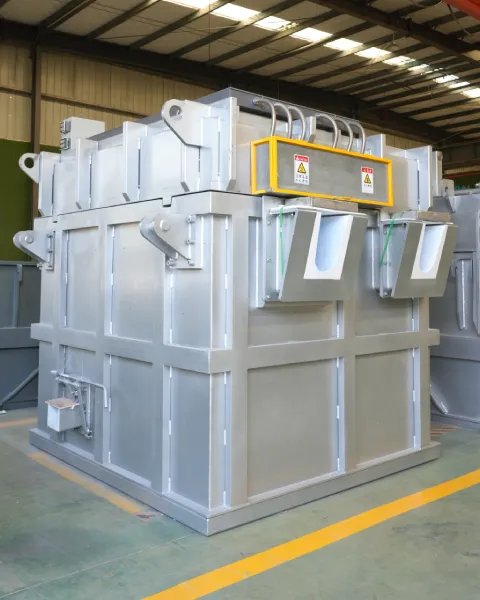
AdTech Deep Bed Filter for Molten Aluminum Filtration
It is a precisely sealed thermal insulation box and forces the aluminum industry to reserve a layer of filter medium with a thickness of about 500mm, usually activated alumina balls. The bottom of the channel is covered with a cover to close and seal the box. The cover also serves to heat the whole unit and preheat the filter bed. The passage consists of two chambers, which have the following characteristics:
There is a filter plate supported by a grid in the treatment chamber, which is on the inlet side.
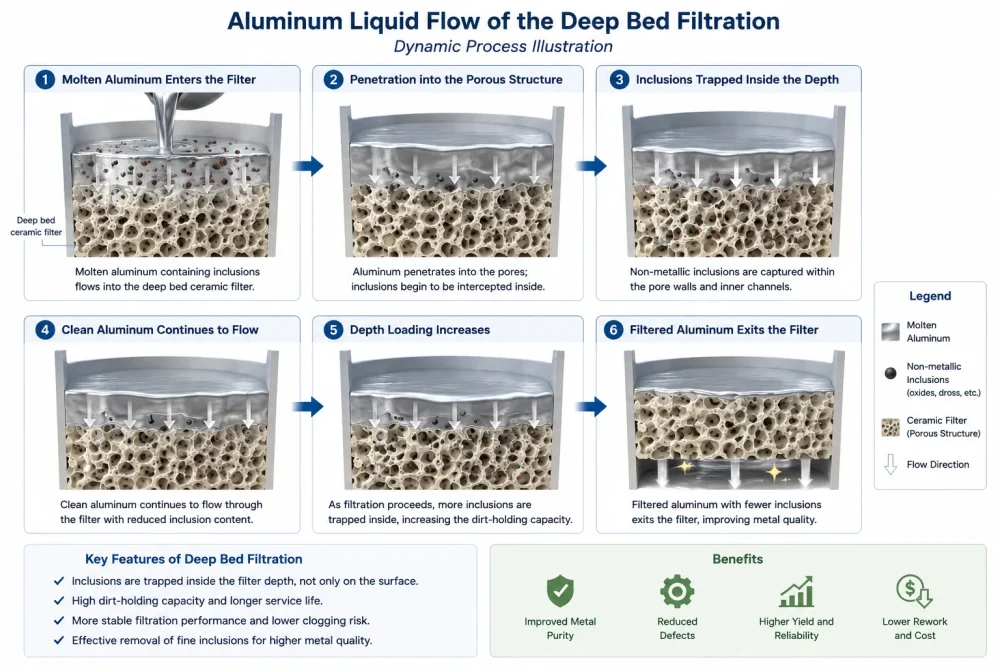
Aluminum Liquid Flow of the Deep Bed Filtration Dynamic Process lllustration
Aluminum liquid flow of the deep bed filtration
Feature
Deep bed filtration has those four advantages and one disadvantage.
Advantages
1. The best filtering effect for removing impurities.
2. Only it can be used for filtering alloy aluminum liquid.
3. Low running cost on filtration process.
4. Biggest filtering flow.
Disadvantages
1. The highest purchase cost.
Parameters
| Alloy aluminum filtering range | Series 1-8 |
| Aluminum liquid temperature | 700-760 |
| Device model | Filtering capacity(T/h) |
| ADBF 10 | 10 |
| ADBF 25 | 25 |
| ADBF 35 | 35 |
| ADBF 45 | 45 |
| ADBF 60 | 60 |
| Customized | Customized |
The Necessity of Melt Purity in Aluminum Fabrication
Inclusions in molten aluminum typically consist of aluminum oxides (Al2O3), carbides, nitrides, and salt inclusions from upstream processes. These impurities lead to surface cracks in profiles, pinholes in aluminum foils, and significant degradation of mechanical properties in plates. Deep Bed Filters utilize a specific gradation of tabular alumina media to create a dense filtration bed. This system leverages the “depth effect” to capture fine particles throughout the entire filter medium, rather than just on the surface.
When compared to Ceramic Foam Filters (CFF), the advantage of a Deep Bed Filter lies in its massive surface area and tortuous path effect. While CFF relies primarily on physical screening for larger inclusions, the DBF system utilizes physical mechanisms such as Brownian motion, interception, and gravity to capture inclusions as small as 1 to 5 microns.
Table 1: Technical Comparison: Deep Bed Filter (DBF) vs. Ceramic Foam Filter (CFF)
| Performance Metric | Deep Bed Filter (DBF) | Ceramic Foam Filter (CFF) |
| Filtration Mechanism | Depth capture, Adsorption, Interception | Surface screening, Mechanical blocking |
| Filtration Efficiency (>10μm) | 98.5% – 99.5% | 70.0% – 85.0% |
| Flow Capacity (T/h) | 10 – 60 Tons per hour (Single unit) | 2 – 20 Tons per hour (Size dependent) |
| Service Life | Continuous operation for 3-6 months | One-time use (Single drop/cast) |
| Initial Investment | Higher (Capital equipment) | Lower (Consumable based) |
| Primary Application | Can body stock, CTP plates, Foil, Aerospace | Standard ingots, Architectural profiles |
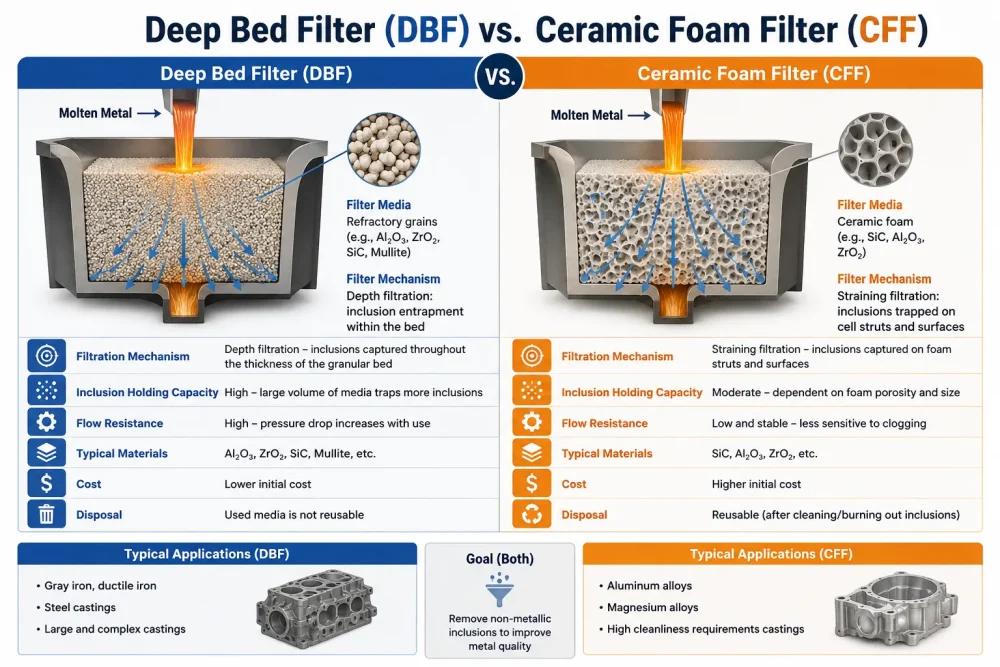
Side-by-side infographic comparing Deep Bed Filter (DBF) and Ceramic Foam Filter (CFF) technologies for molten metal filtration, featuring detailed cross-sectional diagrams of granular media and porous ceramic foam structures, blue and orange flow arrows showing filtration mechanisms, inclusion trapping performance, filtration capacity, flow resistance, cost, disposal methods, and typical casting applications for aluminum, ductile iron, and steel foundries.
Core Architecture of the AdTech ADBF System
The AdTech ADBF series deep bed filter integrates multi-layer graded media technology with precise thermal control systems. The structural design ensures reliability in continuous casting environments:
-
High-Strength Steel Shell: Constructed from corrosion-resistant steel plates with reinforced ribbing. This design ensures structural integrity and prevents deformation under prolonged exposure to temperatures between 700°C and 780°C.
-
Advanced Refractory Lining: Utilizing high-alumina refractory materials, the lining is resistant to aluminum erosion and prevents slag buildup. The design minimizes dead zones in the metal flow, maintaining consistent thermal distribution.
-
Integrated Heating System: Equipped with high-precision silicon carbide heating elements or radiant tubes within the heating lid. This system preheats the filter bed before production begins, preventing metal solidification and ensuring steady-state filtration.
-
Graded Filter Media Bed: The core filtration media consists of high-purity tabular alumina. By scientifically layering different mesh sizes (e.g., 3-6mm, 6-9mm), AdTech creates a gradient structure that maximizes impurity holding capacity.
Table 2: AdTech ADBF Series Technical Specifications
| Model Number | Max Flow Rate (Al T/h) | Media Loading (kg) | Total Power (kW) | Filtration Area (m²) | Applicable Alloy Series |
| ADBF-10 | 10 | 1200 | 24 | 0.8 | 1000, 3000, 8000 |
| ADBF-20 | 20 | 1800 | 36 | 1.2 | All Series |
| ADBF-40 | 40 | 3200 | 52 | 2.1 | 5000, 6000, 7000 |
| ADBF-60 | 60 | 4500 | 75 |
Application
Applying for filtering 1-8 series alloy aluminum.
It is the most efficient aluminum filtration system, which is widely applied in the high-precision aluminum casting industry, such as aerospace aluminum alloy materials supply.
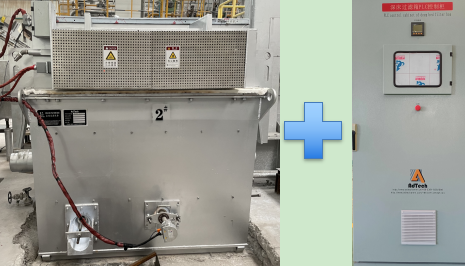
deep bed field use
2025 Case Study: Quality Optimization for an Indian Aluminum Foil Plant
Background and Technical Challenges
In early 2025, a leading aluminum foil manufacturer located in Gujarat, India, encountered a critical quality bottleneck during the production of 0.006mm (double-zero six) ultra-thin foil. Their existing filtration setup was unable to effectively remove dispersed oxides below 10 microns, leading to frequent pinholes and strip breaks during the cold rolling process.
Specific Challenges Faced by the Plant:
-
High Rejection Rate: Pinhole counts exceeded 50 per square meter, significantly higher than the industry standard of 10-15.
-
Production Instability: An average of three strip breaks occurred every 24 hours, resulting in excessive mill downtime and lost capacity.
-
Low Metal Recovery: Poor melt purity led to edge cracking in slabs, requiring increased scalping depth.
AdTech Solution
Following a detailed on-site technical audit, AdTech engineers implemented a customized ADBF-40 Deep Bed Filter system.
Key Features of the Technical Solution:
-
Optimized Media Gradation: For the 8011 alloy produced at the site, a four-layer tabular alumina gradation was utilized to enhance the capture of fine dispersed particles.
-
Fluid Dynamics Simulation: Modeling of the internal flow field was conducted to optimize the inlet and outlet angles, ensuring laminar flow through the bed and preventing the re-entrainment of captured inclusions.
-
Automated Pressure Monitoring: A differential pressure sensor system was installed to provide real-time feedback on bed saturation, allowing the plant to plan media changes without interrupting production cycles.
2025 Performance Results (Verified June 2025)
After three months of continuous operation with the ADBF-40 system, the manufacturer reported the following improvements:
| Performance Metric | Before Upgrade (CFF Only) | After Upgrade (AdTech DBF) | Improvement |
| Pinhole Count (per m²) | 52 – 58 | 8 – 12 | 80% Reduction |
| Mean Time Between Breaks | 8 Hours | 120+ Hours | 14x Improvement |
| Hydrogen Content (ml/100g Al) | 0.18 | 0.12 | 33.3% Reduction |
| Inclusion Removal (>5μm) | 65% | 98.2% | 51% Improvement |
| Economic Impact | – | Approx. $450,000 USD/Year | Significant ROI |
Filtration Dynamics and Physical Principles
The efficiency of a Deep Bed Filter is determined by complex physical and chemical interactions. As the melt flows through the alumina bed, four primary mechanisms occur:
-
Mechanical Interception: Occurs when an inclusion particle’s diameter is larger than the pore space between the filter media.
-
Sedimentation: In low-velocity regions, inclusions with a density higher than the aluminum melt settle onto the media surface due to gravity.
-
Physical Adsorption (Van der Waals Forces): As fine particles pass through the boundary layer of the media, molecular attraction forces pull them toward the surface. Since tabular alumina and aluminum oxide inclusions share similar chemical properties, the affinity is exceptionally strong.
-
Brownian Diffusion: For sub-micron particles, Brownian motion causes them to deviate from the flow lines, increasing the probability of contact with the filter media.
To maintain these effects, the AdTech ADBF system maintains a precise Superficial Velocity. Excessive velocity can shear away captured inclusions, while insufficient velocity reduces throughput. Our control logic maintains velocity fluctuations within a +/- 3% range.
Installation, Operation, and Maintenance Handbook
To ensure maximum performance of the Deep Bed Filter on an aluminum casting line, strict adherence to operational procedures is mandatory.
1. Preheating Phase
The filter bed must be thoroughly preheated before the first metal contact. The AdTech heating lid should be set to 800°C. Preheating typically requires 12 to 16 hours until the bottom layer of the media reaches at least 650°C. This prevents “freeze-up” risks when the molten aluminum enters the chamber.
2. Operational Monitoring
During the casting run, operators must monitor the Pressure Drop. As filtration progresses, the gaps between the media are filled with impurities, causing a gradual increase in pressure. When the pressure differential reaches the critical threshold (typically 150-200mm of metal head), it indicates media saturation.
3. Media Replacement Cycles
While the DBF is a long-life system, regular media replacement is vital. For 1000 series alloys, the cycle can extend up to 6 months. For 5000 series alloys with high magnesium content (which generate MgO rapidly), a replacement cycle of 3 to 4 months is recommended.
Table 3: Filtration Strategies for Specific Aluminum Alloys
| Alloy Series | Primary Impurity Type | Recommended Media | Casting Temp | Key Quality Metric |
| 1000 (Foil/Pure) | Al2O3, Salts | Fine Gradation (3-6mm) | 710°C – 730°C | Pinhole density |
| 3000 (Can Stock) | Mn Segregation | Medium Gradation | 720°C – 740°C | Surface streaks |
| 5000 (Marine) | MgO, Spinels | Mixed Coarse/Medium | 730°C – 750°C | Edge cracking |
| 7000 (Aerospace) | Complex Intermetallics | Precision Multi-layer | 740°C – 760°C | Fracture toughness |
Why Partner with AdTech for Deep Bed Filtration?
In the context of Industry 4.0, AdTech provides more than just equipment; we deliver comprehensive melt purification solutions. Our competitive advantages include:
-
Proprietary Material Science: Our refractory linings and tabular alumina media are developed in-house to ensure chemical compatibility and longevity.
-
Custom Engineering: Every ADBF system is engineered based on the client’s launder height, workshop layout, and specific alloy grades.
-
Global Technical Support: From foil plants in India to extrusion facilities in Southeast Asia, we provide 24/7 technical assistance and on-site maintenance training.
-
Energy Efficiency: Our heating lids utilize the latest fiber-reinforced ceramic modules, reducing heat loss by 25% compared to traditional materials.
Conclusion
Deep Bed Filtration is the essential path for the aluminum industry to achieve “zero-defect” quality. By implementing the AdTech ADBF series, aluminum producers can significantly enhance melt purity, reduce operational costs, and secure a technological lead in the global market.
If you are seeking solutions to improve aluminum foil quality, reduce strip breaks, or produce high-end plate material, contact our technical engineering team for a detailed investment-return analysis.
Frequently Asked Questions (FAQs)
1. What is the main difference between a Deep Bed Filter and a Ceramic Foam Filter?
The primary difference lies in the filtration depth. A Ceramic Foam Filter (CFF) is a surface filter that traps inclusions on its face or within its 20-50mm thickness. A Deep Bed Filter (DBF) utilizes a bed of alumina media approximately 400-600mm deep. This provides a much larger surface area for adsorption and allows it to trap significantly smaller particles (down to 1 micron) compared to the 10-20 micron limit of most CFFs.
2. How often should the tabular alumina media be replaced in a DBF?
The replacement cycle depends on the melt volume and the cleanliness of the incoming metal. On average, for high-quality foil production, the media is replaced every 3 to 6 months. AdTech systems include pressure sensors that notify operators when the bed is becoming saturated, ensuring the media is only replaced when necessary.
3. Can a Deep Bed Filter remove hydrogen from molten aluminum?
While the primary function of a DBF is to remove non-metallic inclusions, it does have a secondary effect on hydrogen. By removing the inclusions that often act as “carriers” or nucleation sites for hydrogen bubbles, the overall gas content in the final casting is often reduced. However, for dedicated degassing, a DBF should be used in conjunction with an inline degasser.
4. What is the required preheating temperature for the filter bed?
To prevent thermal shock and ensure the aluminum does not freeze upon entering the bed, the tabular alumina must be preheated. The heating lid should be set to maintain an internal ambient temperature of 800°C, ensuring the media bed reaches a minimum of 650°C before the metal flow begins.
5. Is the ADBF system suitable for high-magnesium alloys like the 5000 series?
Yes. AdTech offers specific media gradations and refractory linings designed to withstand the more aggressive nature of high-magnesium melts. Because 5000 series alloys generate magnesium oxide (MgO) rapidly, we recommend a slightly coarser top layer in the media bed to prevent premature surface blinding.
Last updated: 05.09.2026 | AdTech Technical Resource Library
Related posts:
 Filtration of molten metal using ceramic filters
 Molten aluminium Filtration
 Aluminum Casting Filtration
 Molten Metal Filtration Export
 Industrial Filters For Filtration Of Molten Aluminium
 High Temperature Metal Aluminium Filtration Casting Filter
 Filtration of Molten Aluminum
 Activated Alumina Ceramic Balls: High Adsorption Desiccant, Filtration Specs
 5052 Aluminum Molten Metal Filtration
 Aluminum Casting-Molten Metal Filtration
The deep bed filter applied for the 3104 aluminum alloy melting
Aluminum Casting-Molten Metal Filtration
The deep bed filter applied for the 3104 aluminum alloy melting
 Liquid aluminum purification and sustainable development in aluminum deep processing
Ceramic foam filter molten metal filtration
Liquid aluminum purification and sustainable development in aluminum deep processing
Ceramic foam filter molten metal filtration
 Ceramic Foam Filter Molten Aluminium Filtration
No Comments