
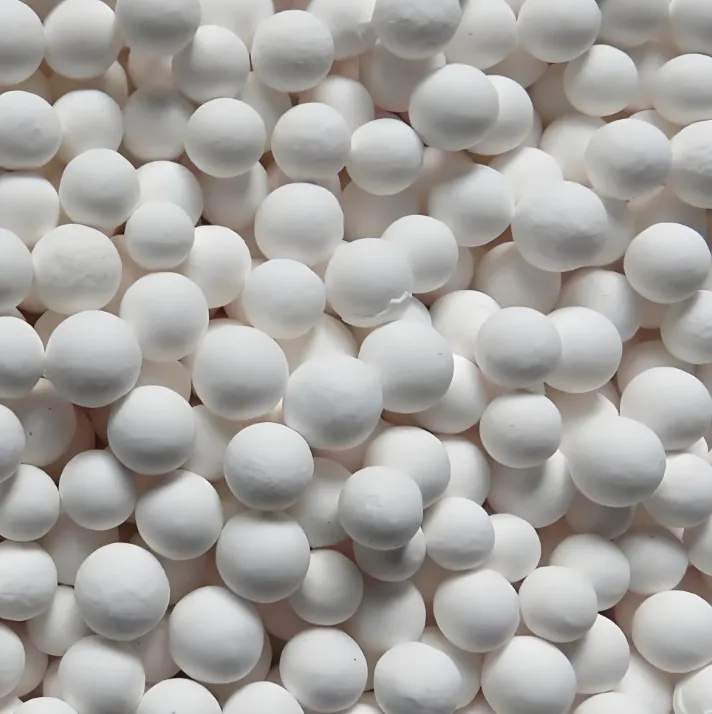
09 Mar Activated Alumina Ceramic Balls: High Adsorption Desiccant, Filtration Specs
Activated alumina ceramic balls combine very high surface area, tuned pore architecture, robust mechanical strength, and reliable thermal stability, making them a top choice when moisture removal, gas drying, selective contaminant capture, or support media in filtration beds is required. These porous spheres deliver predictable adsorption capacity in industrial gas and liquid streams, withstand repeated thermal regeneration cycles when handled correctly, and provide a cost effective service life in foundry and metallurgical settings where moisture control and particulate management influence product quality.
1. Technical summary and takeaways
Porous alumina spheres deliver moisture adsorption through a network of micro and mesopores that yields high specific area. Typical commercial grades present surface areas between roughly 300 and 415 square meters per gram and bulk densities that vary by composition and firing protocol. Adsorption capacity depends on relative humidity, temperature, and pore volume. Thermal regeneration commonly uses elevated temperature with dry purge gas to restore capacity. Mechanical strength, abrasion resistance, and attrition loss dictate service life in packed beds subjected to flow turbulence. Manufacturer performance data and independent adsorption studies confirm that these media provide stable, reproducible performance when integrated into dryer vessels, gas purification trains, or filtration support layers.
If your project requires the use of activated alumina ceramic balls, you can contact us for a free quote.
Activated Alumina Ceramic Balls
2. Material science background: what porous alumina spheres are
Activated alumina is a high surface area form of aluminum oxide derived from thermal treatment and activation of alumina precursors. Activation creates a hierarchical pore network that includes micropores that dominate adsorption of small polar molecules like water vapor, plus mesopores that help rapid mass transfer. The primary phases are transition aluminas with retained porosity. Physical characteristics that define performance include surface area, pore volume, pore size distribution, bulk density, and crush strength.
Key microstructural features that govern adsorption behavior include:
-
Internal surface chemistry with amphoteric hydroxyl sites that interact strongly with polar molecules.
-
Capillary condensation within mesopores under elevated vapor pressure.
-
Hydrophilic binding energy distribution that sets the shape of the adsorption isotherm.
Scientific investigations of equilibrium isotherms indicate that water uptake on activated alumina follows characteristic profiles that depend on temperature. These data are central to sizing beds intended to reduce dew point or maintain low moisture levels in process gases.
3. Manufacturing routes and common grades
Production typically follows one of these pathways:
-
Precipitation from aluminum salt solutions followed by shaping into spheres, drying, firing, then chemical activation to develop porosity
-
Extrusion or spray granulation into near-spherical beads, followed by controlled calcination and activation steps
-
Impregnation or coating of inert ceramic cores to create composite beads with tailored surface chemistry
Commercial grades often carry identifiers linked to nominal surface area and pore volume. Typical trade grades include high surface area desiccant beads with area ~350 to 415 m²/g. Lower surface area inert alumina balls exist that primarily offer structural support under filter layers rather than moisture adsorption. Manufacturer product sheets present grade codes and size ranges from 1 mm up to 12 mm diameter depending upon intended application.
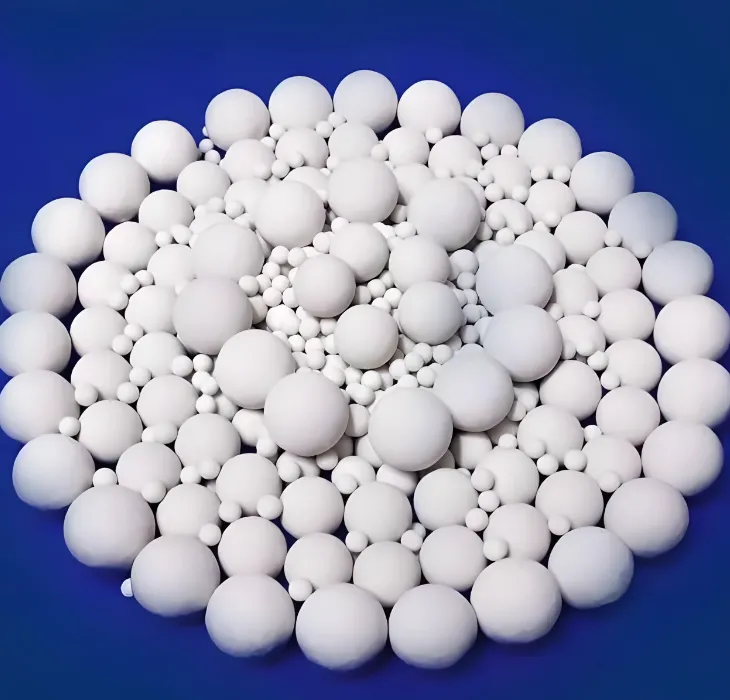
Activated alumina ceramic ball filter media
4. Physical and chemical specification (table)
Table 1. Typical specification sheet for activated alumina ceramic balls
| Property | Typical value range | Units | Notes |
|---|---|---|---|
| Apparent surface area | 300 to 415 | m²/g | BET measurement under nitrogen |
| Pore volume | 0.4 to 0.9 | mL/g | Total pore volume, related to max uptake |
| Mean pore diameter | 2 to 20 | nm | Micro/mesopore distribution influences kinetics |
| Bulk density | 0.8 to 1.6 | g/cm³ | Depends upon firing and composition |
| Particle size available | 1 to 12 | mm | Common media sizes used in packed beds |
| Crush strength (single particle) | 80 to 600 | N or lbf | Manufacturer test methods vary |
| Attrition loss | <0.5 | % weight loss over specified test | Higher attrition shortens useful life |
| Chemical composition | Al₂O₃ >85 | wt% | Impurities controlled to limit side reactions |
| pH point of zero charge | ~7 to 9 | — | Surface acidity/basicity affects selectivity |
| Thermal stability | up to 900 | °C | Structural stability versus sintering risk |
Sources include manufacturer datasheets and technical reviews that summarize common industry ranges. Real-world values depend upon a chosen product grade and production route.
5. Adsorption performance: mechanisms, isotherms, and numerical capacity
Mechanisms that dominate water capture
Water molecules adhere to hydrophilic surface sites first. At low partial pressures coverage is limited to monolayer adsorption on high energy sites. With rising vapor pressure, capillary condensation fills mesopores and uptake increases sharply. The overall shape of the isotherm commonly resembles a type II or V behavior depending upon pore structure and temperature.
Representative equilibrium data and interpretation
Published measurements show a wide spread in equilibrium capacity because pore volume largely controls saturation uptake. Typical values reported in experimental studies and catalogs include equilibrium water uptake of roughly 0.1 to 0.4 grams water per gram of alumina at moderate humidities and room temperature. Under near saturation humidity, total uptake may approach the pore-limited maximum which can exceed 1.0 grams per gram in some very porous samples. These ranges are context dependent and should be validated against a supplied product isotherm when designing a plant.
Example adsorption isotherm interpretation
-
Low humidity (partial pressure <0.1): primary adsorption on high energy hydroxyl sites; capacity modest.
-
Moderate humidity (0.1 to 0.6): mesopore filling increases capacity rapidly.
-
High humidity (>0.6): pore saturation; total capacity approaches theoretical pore volume limit.
Designers use isotherm data to set acceptable breakthrough criteria expressed in dew point or parts per million by volume (ppmv) moisture. Engineering correlations convert equilibrium capacity into required bed mass using expected inlet humidity, desired outlet humidity, and planned cycle time.
6. Operational design: bed sizing, pressure drop, contact time, replacement intervals
Key design variables
-
Inlet conditions: temperature, pressure, moisture partial pressure.
-
Desired outlet dew point or ppmv target.
-
Acceptable pressure drop across packed bed.
-
Cycle length: planned adsorption run time before regeneration or swap.
Simple mass calculation (illustrative)
Required adsorbent mass = (mass of water to remove per cycle) ÷ (usable adsorption capacity per mass of media).
Usable capacity is lower than equilibrium capacity because designers leave safety margin against breakthrough and account for incomplete utilization near bed exhaust.
Hydrodynamics and pressure loss
Packed beds of spherical beads produce predictable pressure drop based upon particle diameter, bed depth, and superficial velocity. Use standard Ergun-type correlations to compute headloss. Choose bead diameters to balance low pressure drop and adequate gas-solid contact. Smaller beads increase surface area but raise pressure loss and risk of attrition.
Changeout intervals and expected lifetime
Service life is linked to attrition, contamination by particulates or oils, and chemical poisoning. In industrial gas service, a bed may remain effective for months to years when periodic regeneration is used. In heavily contaminated streams, media replacement may be frequent. Monitor outlet dew point and pressure drop to determine replacement timing.
7. Regeneration methods, thermal profiles, and cautions
Thermal regeneration remains the most common restoration technique. Typical practice includes heating the bed under purge gas that carries desorbed moisture away. Recommended temperature ranges vary by grade. Industry references and manufacturers indicate regeneration commonly occurs between 180 and 350 °C, with many practitioners using around 280 °C held for several hours while flushing with dry gas. Controlled ramp rates limit thermal stress and minimize attrition.
Regeneration step sequence
-
Isolate adsorption vessel from process stream
-
Apply purge gas with low outlet dew point; begin heating at controlled ramp rate
-
Maintain target temperature until desorption curve approaches baseline
-
Cool under dry purge until handling temperature reached
-
Return to service
Operational cautions
-
High temperature desorption without purge may cause steam generation inside the bed which can damage pore structure; use continuous purge.
-
Presence of oils, sulfur compounds, or heavy organics can chemically alter surface sites and reduce capacity irreversibly. Pretreatment filtration or guard beds help.
-
Repeated extreme heating without controlled atmosphere risks sintering that reduces surface area.
Research into assisted regeneration methods such as ultrasound and microwave heating shows potential to reduce energy consumption, though practical adoption depends upon capital and operational considerations.
8. Applications most relevant to aluminum casting and foundry operations
Activated alumina beads are useful in several process steps tied to metal quality control.
Gas drying and inert gas handling
Dry, inert gases such as nitrogen or argon are often used in casting equipment control and melt protection. Removing moisture from these gases prevents oxidation reactions and hydrogen pickup in molten aluminum, which can reduce porosity in castings. Packed dryer vessels loaded with activated alumina help maintain dew points that reduce hydrogen solubility in aluminum melts.
Filtration bed support and multi-layer filtration
Porous alumina spheres perform double duty when placed beneath a primary filter layer. Their mechanical resilience helps equalize flow, reduce channeling, and support ceramic foam filters that directly contact molten metal. In water treatment contexts, activated alumina can participate in fluoride capture when combined with appropriate pretreatment steps.
Catalyst support and odor control
High surface area alumina beads often serve as catalyst carriers in processes used in foundry off-gas treatment where chemisorption or catalytic conversion of pollutants reduces emissions.
9. Comparison with alternative desiccants and filter supports
Table 2: Quick comparison of common adsorbent media
| Feature | Activated alumina | Silica gel | 3A/4A molecular sieve |
|---|---|---|---|
| Typical surface area | 300 to 415 m²/g | 600 to 750 m²/g | 400 to 800 m²/g |
| Optimal temperature range | up to 300 °C regeneration | up to 150 to 200 °C regeneration | up to 350 °C regeneration |
| Moisture affinity at low RH | moderate/high | high | very high |
| Selectivity for organics | moderate | moderate | variable depending on pore size |
| Mechanical strength | high | moderate | high |
| Typical use cases | gas drying at elevated temp, support beds | low temp drying, lab grade | ultra-low dew point, drying of compressed air |
Selection rationale: choose porous alumina when mechanical robustness and moderate-to-high temperature regeneration are required. Molecular sieves may be chosen when extremely low outlet moisture content is required despite higher cost.
10. Quality control, inspection, handling, packaging, disposal
Incoming batch inspections
-
Verify certificate of analysis showing surface area, pore volume, particle size distribution, and crush strength
-
Randomly sample for attrition fines and measure bulk density
-
Record lot numbers and manufacturer identification
Handling and storage
-
Store in dry, sealed containers, humidity below 10% relative humidity ideal
-
Avoid mechanical impact that produces fines
-
Use sealed transfer methods when loading vessels to avoid contamination
Disposal
Used adsorbent with negligible contamination may be landfilled under local regulations. Contaminated media that has captured hazardous components must be handled under hazardous waste rules. Consult local environmental regulations.
11. Technical selection tables
Table 3. Sizing example (illustrative calculation)
| Parameter | Value |
|---|---|
| Inlet flow | 1000 Nm³/h |
| Inlet moisture | 5000 ppmv (approx dew point -20 °C at 25 °C) |
| Required outlet moisture | 100 ppmv |
| Cycle time desired | 24 hours |
| Calculated water mass to remove per day | ~? (engineer must compute using gas molar flow) |
| Usable capacity assumed | 0.2 g water per g alumina |
| Required media mass | (computed water mass) ÷ 0.2 |
Note: This table is illustrative. Project engineers must use isotherm data and gas laws to compute exact mass. Supplier product isotherms should be used for final sizing.
12. Procurement checklist and suggested PO language
When issuing a purchase order include:
-
Product grade name and surface area (m²/g) requirement.
-
Particle size distribution or nominal diameter in mm.
-
Maximum permissible attrition loss percentage after specified mechanical test.
-
Minimum crush strength per particle or compressive strength metric.
-
Bulk density and packing density expectations.
-
Certificate of analysis requirement and sample quantity to be supplied.
-
Packaging specification including moisture barrier liners and drum or sack grades.
-
Warranty period and return policy for defective lots.
Suggested clause example in technical terms (short form): “Activated alumina ceramic balls with minimum BET surface area 350 m²/g, mean particle diameter 3.2 mm, maximum attrition loss 0.5% per ASTM-equivalent test, bulk density 1.05 g/cm³ nominal, delivered in sealed 25 kg moisture-barrier bags with CoA.”
13. FAQs
Activated Alumina: 10/10 Adsorption FAQ
1. What drives the water uptake capacity of activated alumina beads?
Internal pore volume and high surface area (typically 300-350 m2/g) dominate uptake. Surface chemistry influences initial site binding, while mesopores control the bulk uptake capacity required for industrial desiccant applications.
2. Which regeneration temperature should be used?
Typical thermal regeneration spans about 180 to 350°C. Many suppliers recommend holding the temperature at approximately 280°C for several hours under a dry purge gas to fully restore the adsorption capacity.
3. Can these beads be regenerated on-site?
4. How do I select bead diameter?
5. What contaminants shorten service life?
6. Is activated alumina safe for use near molten aluminum?
7. How does temperature influence adsorption?
Higher gas temperatures reduce the equilibrium uptake at a given partial pressure. Effective adsorption is an exothermic process; design should account for operating temperature variations to prevent premature bed saturation.
8. What testing confirms media quality upon receipt?
Standard Quality Checklist:
- BET Surface Area (m2/g)
- Pore Volume (cm3/g)
- Bulk Density & Particle Size Analysis
- Crush Strength & Attrition Rate
9. Can beads remove fluoride or arsenic from water?
10. How will I detect bed breakthrough during service?
Monitor the outlet dew point or moisture content (ppmv) with suitably calibrated analyzers. A rising moisture trend indicates the mass transfer zone is reaching the bed exit, signaling approaching breakthrough and the need for regeneration.
14. Closing notes and recommended references
Activated alumina ceramic balls present a robust, high-performance option in many drying and filtration roles within foundry and metallurgical contexts. For plant implementation, rely upon manufacturer-supplied isotherms and mechanical data while validating in pilot trials under true process conditions. A useful starting point is supplier technical literature from reputable makers, accompanied by peer reviewed adsorption studies that quantify isotherms and regeneration energy needs. Representative technical sources include manufacturer product pages and adsorption science literature which summarize observed behavior and regeneration protocols.
Related posts:
 High Porosity Ceramic Filter
 Alumina Ceramic Filtration
 Alumina Filter Filtration
 High Alumina Ceramic Cone
 High Temperature Metal Aluminium Filtration Casting Filter
 High Alumina Fiber Flow Box
 Alumina Ceramic Foam Filter Casting Filtration
 Alumina Ceramic Foam Filter Manufacturers
 High Strength Ceramic Filter
 Alumina Porous Ceramic Foam Filter Plate
 Alumina Ceramic Foamfilter Casting Filtration
 Alumina Ceramic Filtration
 Alumina Silicate Cone
 Economic Porous Alumina Ceramic Foam Filter
No Comments