

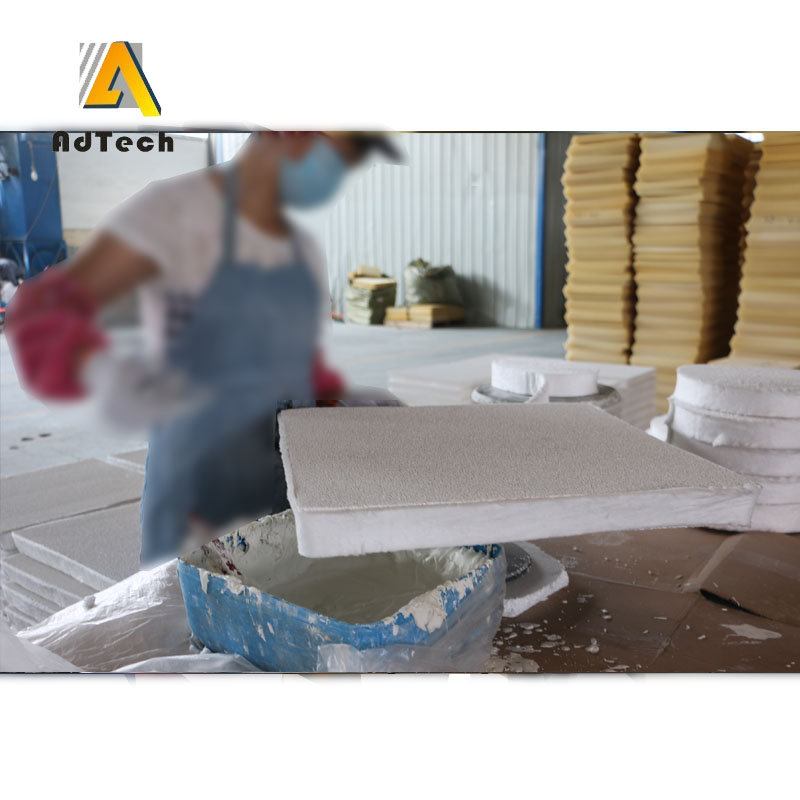
12 de septiembre Cómo fabricar un filtro de espuma cerámica
Cómo hacer Filtro de espuma cerámica
Adtech te explicará cómo fabricar un filtro de espuma cerámica.
Preparación de una pasta para la impregnación de espuma de poliuretano: se mezclan la sal de potasio y el ácido fosfórico en un recipiente hasta que se neutralicen por completo.
A continuación, se añade un aglutinante de cromofosfato de aluminio y, tras ello, bajo agitación constante, se incorporan los componentes sueltos: material fundido, hidróxido de aluminio, carga y residuos de filtro cerámico espumoso finamente molidos.
Se sigue agitando la suspensión durante 30-40 minutos hasta que se alcance una homogeneización completa.
¿Cómo se fabrica un filtro de espuma cerámica?
Se impregnan las piezas de espuma de poliuretano, que presentan una estructura elástica de poros abiertos, con una barbotina cerámica preparada, y se elimina el exceso de suspensión.
El producto semiacabado se seca a una temperatura de entre 100 y 130 °C hasta alcanzar un peso constante y, a continuación, se cuece a una temperatura máxima de entre 1280 y 1290 °C.
Se sometieron a ensayo los filtros de espuma terminados para determinar su resistencia mediante filtración durante la fundición de aleaciones de aluminio.
La composición de las masas propuestas y las características físico-técnicas del prototipo se obtuvieron durante los ensayos de los filtros de espuma.
La solución propuesta permite aumentar la resistencia mecánica y térmica de los filtros de espuma cerámica.
Los filtros de espuma cerámica de la masa propuesta presentan unas características muy favorables, con mayores índices de resistencia mecánica y térmica y, lo que es muy importante, debido a la ausencia de grietas en el cuerpo cerámico, ofrecen una elevada resistencia a la fractura por flexión, lo que repercute positivamente en la calidad del metal que se está limpiando.
Además, la incorporación de residuos finamente triturados procedentes del PCF permite organizar una producción de filtros de espuma cerámica sin residuos.
Los filtros de espuma cerámica se utilizan para eliminar las impurezas de las piezas de fundición metálica.
Los filtros a base de PPU eliminan las impurezas gracias a su estructura porosa abierta. Durante el proceso de fundición, el metal fundido discurre a través de los poros. En el caso de los filtros de espuma cerámica, el PUF actúa como matriz para el proceso catalítico posterior. La espuma se recubre con una suspensión cerámica y se seca. A continuación, las piezas en bruto de diversas formas se introducen en el horno, donde la matriz de espuma de poliuretano reticulada se quema, dejando tras de sí una estructura de malla cerámica que constituye el filtro acabado. El tamaño de los poros de los filtros cerámicos oscila entre 10 y 45 PPI por pulgada lineal.
La estructura de malla del filtro de espuma cerámica proporciona una filtración profunda, que elimina minuciosamente una gran cantidad de impurezas sin dejar residuos.
El filtro puede soportar una presión metalostática considerable sin perder eficacia en la filtración. Los filtros de espuma cerámica se utilizan habitualmente en la fundición primaria y secundaria de aluminio, así como en los hornos de fundición de aluminio.
Los filtros de espuma cerámica presentan las siguientes ventajas
1. Filtración de impurezas metálicas y no metálicas de los flujos de metal fundido.
2. Reducción del óxido durante la formación del flujo turbulento.
3. Aumento del flujo de metal.
4. Eliminación de inclusiones y diversos defectos metálicos.
5. Al mejorar la calidad de la fundición, los filtros PPU presentan buenas propiedades mecánicas.
6. Reducción de los desechos y del trabajo adicional en la producción.
7 La cerámica filtro de espuma está disponible en una amplia variedad de tamaños y formas.
8 Todos los filtros de espuma cerámica se caracterizan por una matriz de malla, en la que los poros esféricos, de tamaño y volumen uniformes, están conectados a lo largo de todo su volumen y forman ventanas a través de sus paredes. Los recovecos de esta estructura permiten el paso y, al mismo tiempo, la captura de escoria fundida y otros contaminantes. Como resultado, esta estructura de filtro única basada en PPU muestra una eficiencia de filtración de metales superior en comparación con otras estructuras y filtros del mercado de la fundición.
9 Los filtros de espuma cerámica presentan una elevada resistencia al calor y se impregnan fácilmente con metal fundido. La durabilidad superior de los filtros a base de PPU elimina la necesidad de utilizar rejillas metálicas adicionales.
10 La mejora de la calidad de la fundición se consigue filtrando las escorias que se forman en el metal fundido durante el proceso de fundición. Con la ayuda de filtros basados en PPU, se mejora la calidad de la pieza fundida final, se mejora la trabajabilidad del metal, se reducen al mismo tiempo los residuos de fundición y se aumentan las velocidades de producción de las líneas.
11 Los poros de los filtros de espuma cerámica actúan como “trampas” para diversas impurezas. Esta estructura de filtro ofrece ventajas frente a los filtros cerámicos estándar convencionales. Cuando la masa fundida de metales ferrosos entra en contacto con la superficie del filtro de espuma cerámica, los aditivos especiales que componen el recubrimiento del filtro comienzan a descomponerse y forman instantáneamente una película continua de fayalita. Este recubrimiento se vuelve blando y viscoso a altas temperaturas, y la película de fayalita retiene incluso las inclusiones de tamaño micrométrico a medida que pasan a través del filtro. Los filtros cerámicos convencionales no son capaces de capturar por completo tantas impurezas del metal fundido.
Al utilizar filtros de espuma de poliuretano en la producción, se consigue un metal más limpio, se mejora su fluidez y, en general, la calidad de la pieza fundida final, lo que se traducirá en un aumento de los beneficios de la planta y la fundición.
1. What is a Ceramic Foam Filter and How Does It Work?
A Filtro de espuma cerámica (CFF) is a porous, highly refractory ceramic material characterized by a three-dimensional open-cell network (reticulated structure). Designed to withstand extreme temperatures, thermal shock, and molten metal erosion, CFFs are predominantly used in continuous, semi-continuous (DC casting), and shape casting of aluminum alloys.
The Three Filtration Mechanisms
- Mechanical Straining (Screening): Large oxide skins and refractory slag particles larger than the filter pore opening are mechanically trapped on the entry face of the filter plate.
- Cake Filtration: As trapped particles accumulate at the filter surface, they form a “filter cake.” This layer subsequently acts as a secondary filter medium, capturing particles smaller than the initial pore diameter.
- Deep-Bed Adsorption: Microscopic non-metallic inclusions pass into the tortuous 3D network of the reticulated ceramic structure. Due to inertia, thermal convection, and capillary action, these inclusions contact the ceramic strut surfaces and adhere to them via physical adsorption.
Core Benefits for Aluminum Cast Houses
- Dross & Inclusion Reduction: Removes non-metallic particles down to a few microns, dramatically lowering rejection rates during X-ray testing.
- Laminar Flow Stabilization: Reduces turbulence during mold filling, minimizing secondary oxidation and air entrapment.
- Improved Mechanical Properties: Enhances yield strength, fatigue resistance, and surface finish of extruded profiles, aluminum foils, and aerospace-grade sheets.
- Machining Tool Longevity: Decreases hard spot density, significantly reducing tool wear during CNC milling and cutting operations.
2. Step-by-Step Ceramic Foam Filter Manufacturing Process
The dominant industrial method for producing high-porosity reticulated ceramic foam filters is the Organic Sponge Impregnation Method (also known as the Schwartzwalder Process). Below is the precise 6-step manufacturing workflow.
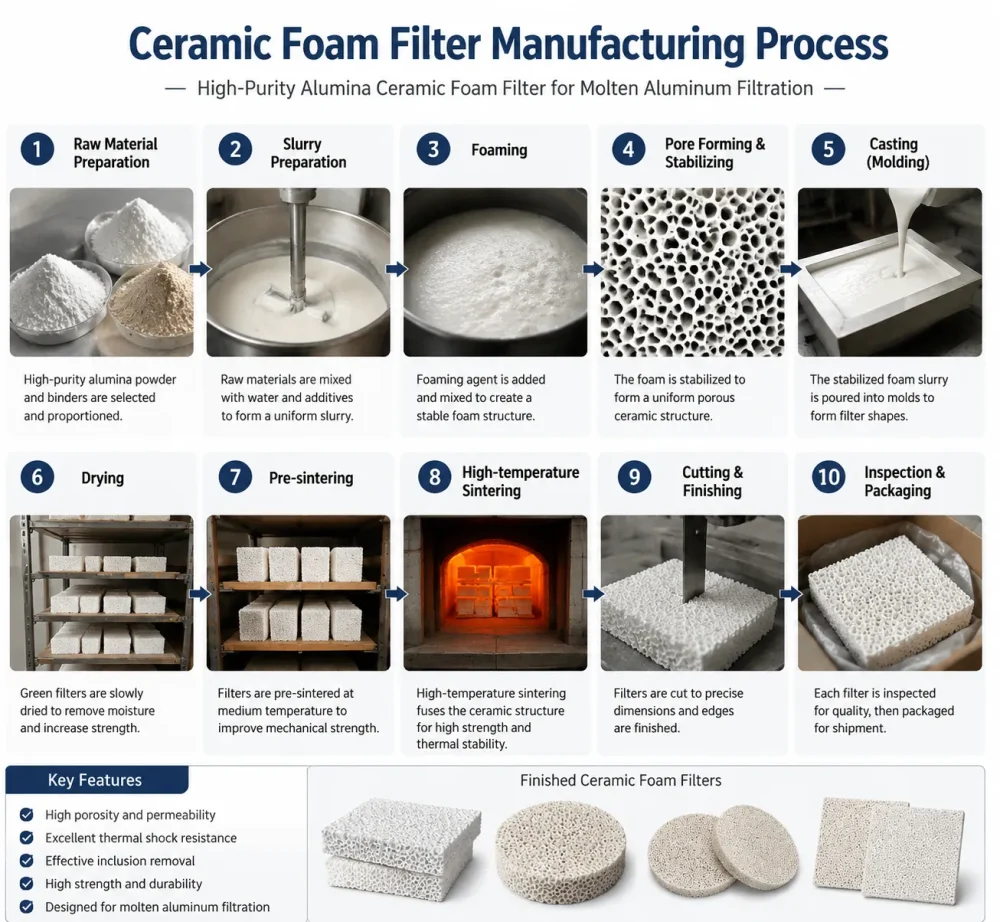
Alumina Ceramic Foam Filter manufacturing process including mixing, molding, sintering, inspection and packaging.
Step 1: Polyurethane Sponge Selection and Pre-treatment
- Base Material: Flexible, fully reticulated open-cell polyurethane (PU) foam serves as the sacrificial template.
- Pore Uniformity: The PU foam must feature uniform pore size distribution, specified in PPI (Pores Per Inch).
- Thermal Pre-treatment: The foam template is heat-treated or chemically etched to remove residual cell membranes, ensuring 100% open porosity and optimal slurry adhesion.
Step 2: Ceramic Slurry Preparation & Impregnation
- Slurry Formulation: High-purity alumina (Al2O3), silica (SiO2), binder agents (e.g., aluminum phosphate or colloidal silica), rheological additives, and anti-foaming agents are blended in a high-shear mixer.
- Viscosity Control: Slurry rheology must exhibit thixotropic behavior—flowing easily under stress while maintaining a stable structure at rest to coat foam struts evenly without clogging pores.
- Dipping Process: The pre-cut PU foam matrices are submerged in the ceramic slurry, ensuring complete wet-out of all internal struts.
Step 3: Mechanical Rolling and Excess Slurry Removal
- Squeezing Action: The impregnated foam passes through precision-calibrated roller presses to squeeze out excess slurry.
- Web Thickness Retention: Controlled clearance settings on the rollers maintain optimal ceramic strut coating thickness while preserving open passage channels.
Step 4: Controlled Drying Phase
- Moisture Evaporation: The coated foam blocks undergo drying in continuous tunnel dryers or microwave drying systems operating between 100°C and 150°C.
- Crack Prevention: Humidity and temperature profiles are carefully regulated to prevent shrinkage cracks, warpage, or structural deformation.
Step 5: High-Temperature Sintering
- Polyurethane Burn-out: As temperature reaches 300°C to 600°C in the sintering kiln, the internal polyurethane foam template burns out completely without leaving toxic carbon residue.
- Ceramic Bonding: The kiln ramps up to sintering temperatures between 1100°C and 1500°C (depending on binder and alumina purity). Thermal sintering fuses ceramic grains together, developing high mechanical strength and thermal shock resistance.
Step 6: Edge Gasket Application & Quality Inspection
- Thermal Expansion Gasket: Expandable ceramic fiber or refractory gasket strips are fitted around the edges of the filter plate to ensure a tight seal inside the filter box, preventing molten metal bypass.
- Dimensional & Visual QC: Each filter plate undergoes dimensional tolerance verification, pore density checks, and structural integrity testing.
3. Key Technical Specifications & Material Comparison
Selecting the correct ceramic material matrix is crucial to withstand thermal stress and chemical reaction with specific molten alloys.
| Property / Parameter | Alumina (Al2O3) Ceramic Filter | Silicon Carbide (SiC) Filter | Zirconia (ZrO2) Ceramic Filter |
|---|---|---|---|
| Primary Alloy Application | Aluminum, Al-Mg Alloys, Zinc | Cast Iron, Ductile Iron, Copper Alloys | Carbon Steel, Stainless Steel, Superalloys |
| Max Operating Temp | Up to 1150°C (2102°F) | Up to 1500°C (2732°F) | Up to 1700°C (3092°F) |
| Porosity Rate | 80% – 90% | 80% – 85% | 75% – 85% |
| Flexural Strength | ≥ 0,8 MPa | ≥ 1,5 MPa | ≥ 2.0 MPa |
| Resistencia al choque térmico | Excelente | Superior | Outstanding |
| Inercia química | Highly Resistant to Molten Al | Highly Resistant to Slag | High Resistance to Corrosion |
Standard Physical Specifications (Alumina CFF for Aluminum)
- Chemical Composition: Al2O3 ≥ 85%, SiO2 ≤ 10%
- Densidad aparente: 0.40 – 0.55 g/cm³
- Cold Compressive Strength: ≥ 0.5 MPa
- Thermal Expansion Coefficient: 7.5 × 10⁻⁶ /K
4. How to Choose the Right PPI for Aluminum Casting
Pores Per Inch (PPI) defines the pore density of a ceramic foam filter. Selecting the appropriate PPI depends on your casting method, alloy cleanliness requirements, and molten metal flow rate goals.
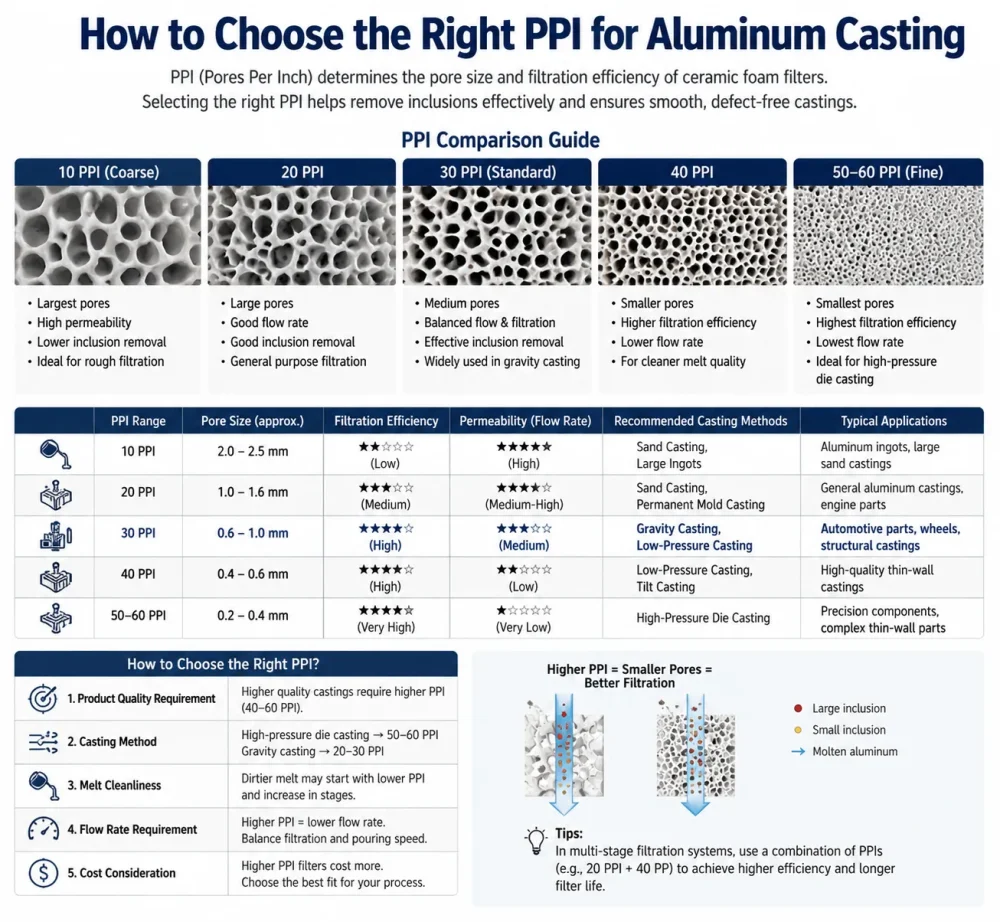
Ceramic foam filter PPI selection guide showing 10–60 PPI pore size, filtration efficiency and aluminum casting applications
PPI Selection Matrix
10 PPI to 20 PPI (Coarse Filtration)
- Primary Uses: Primary aluminum remelt, foundry ingot production, scrap recycling, and gravity casting.
- Key Characteristics: High volumetric flow rate, high dirt-holding capacity, low initial priming head requirement.
- Target Inclusions: Removes large dross particles, furnace lining flakes, and coarse oxide skins.
30 PPI to 40 PPI (Medium-Fine Filtration)
- Primary Uses: Direct Chill (DC) casting of extrusions, aluminum billets, rolling slabs, and automotive component foundries.
- Key Characteristics: Balanced performance offering efficient micro-inclusion removal alongside stable flow velocity.
- Target Inclusions: Traps intermediate non-metallic inclusions down to 30 microns.
50 PPI to 60 PPI (Ultra-Fine / Precision Filtration)
- Primary Uses: High-precision aluminum foil stock, aerospace alloys, lithographic sheet production, and ultra-thin wire drawing.
- Key Characteristics: High filtration efficiency with tight pore channels. Requires preheating and higher molten metal priming head pressure.
- Target Inclusions: Captures micro-inclusions down to 5–10 microns.
5. Application Scenarios & Filter Box Installation Best Practices
Correct installation and preheating of ceramic foam filters in casting operations are critical to preventing molten metal bypass, thermal shock breakage, and cold folds.
Step-by-Step Installation Guidelines
- Inspect Filter Box & Seating: Clean the filter bowl or launder box thoroughly. Remove residual aluminum, oxide scale, or damaged lining refractory.
- Apply Expansible Gasket: Ensure the expandable ceramic fiber sealing gasket wraps tightly around all four sides of the filter plate.
- Position the Filter: Place the filter plate flush into the filter bowl seat. Press down evenly to verify there are no gaps along the perimeter where un-filtered liquid metal could bypass.
- Preheating Sequence: Preheating the filter plate using burner flames or electric heating elements is mandatory before casting starts:
- Target Preheat Temperature: 300°C to 500°C (572°F to 932°F).
- Purpose: Prevents thermal stress cracking upon contact with molten metal and ensures instant priming without freezing.
- Priming & Flow Rate Control: Maintain an adequate metal head height (typically 50–150 mm) during initial pour to overcome surface tension and prime the filter pores.
6. Troubleshooting Common Filtration Failures
| Issue / Symptom | Root Cause Analysis | Plan de medidas correctivas |
|---|---|---|
| Filter Floating / Displacement | Missing or incorrectly sized edge gasket; improper filter seating inside the bowl. | Use correct ceramic fiber gasket thickness to ensure tight mechanical wedge fit. |
| Metal Priming Failure (No Flow) | Filter temperature too low during pour; selected PPI too fine for available liquid metal head pressure. | Increase filter box preheat temperature; switch to a lower PPI filter (e.g., from 50 PPI to 30 PPI). |
| Filter Structural Cracking | Severe thermal shock due to non-uniform or insufficient preheating; physical impact during loading. | Standardize burner preheat sequence; handle filter plates carefully using thermal protective gear. |
| Inclusion Bypass / Downstream Defect | Damaged edge gasket allowing molten metal to bypass filter; cracks inside filter matrix. | Inspect gasket seal prior to casting; verify cold compressive strength specifications from supplier. |
7. Frequently Asked Questions (FAQ)
Q1: What is the standard lifespan of an alumina ceramic foam filter?
Alumina ceramic foam filters are designed primarily for single-cast usage in continuous and semi-continuous casting runs. They should be replaced after every drop/cast or once maximum inclusion load capacity is reached to avoid channel clogging and pressure drops.
Q2: Why is the expandable gasket around the filter plate critical?
The ceramic fiber gasket serves two vital functions: first, it seals the perimeter to prevent liquid aluminum from leaking past the sides without being filtered; second, it expands under high casting temperatures to securely lock the filter plate in position, preventing it from floating.
Q3: How do I determine whether to use a 30 PPI or 50 PPI filter?
Base your selection on your end product quality specifications. If you are manufacturing standard industrial extrusions or billets, 30 PPI provides excellent flow efficiency and clean melt quality. If you produce foil stock, lithographic plates, or aerospace components, 50 PPI or 60 PPI is necessary to remove fine micro-inclusions.
Q4: What is the main difference between Alumina (Al2O3) and Silicon Carbide (SiC) foam filters?
Alumina (Al2O3) filters are specifically formulated for aluminum and non-ferrous alloy casting up to 1150°C. Silicon Carbide (SiC) filters exhibit much higher mechanical strength and temperature resistance up to 1500°C, making them suitable for iron, brass, and bronze foundry applications.
Technical Consultation & Procurement Solutions
Are you seeking to improve your casting yield, reduce dross rejection rates, or custom-engineer ceramic foam filter sizes for your aluminum furnace launder system?
Contact the metallurgical engineering team at AdTech today for technical datasheets, custom PPI configurations, and factory-direct volume quotes.
Artículos relacionados:
 Filtro cerámico de espuma para la filtración en fundición
 Filtro de espuma cerámica de alúmina, Pakistán, aluminio
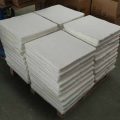 Utiliza un filtro de espuma cerámica de alúmina
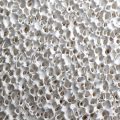 Estructura interna del filtro de espuma cerámica de alúmina
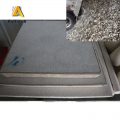 ¿Qué es un filtro de espuma cerámica?
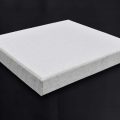 Filtro de espuma cerámica de Chuo Kosan
 Filtro cerámico de espuma de Australia
 Comprar filtro de espuma cerámica de alúmina
 Filtro cerámico de espuma de aluminio Siberia
 Filtro de espuma cerámica de la empresa Mozal
 Utiliza filtros de espuma cerámica para la fundición
 Filtro de espuma cerámica con alto contenido en aluminio
 Filtro de espuma cerámica Uaz de aluminio
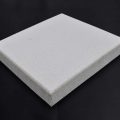 Filtro de espuma de aluminio y cerámica Katagi
Sorry, the comment form is closed at this time.