

6 أغسطس عملية إزالة الغازات من الألومنيوم
عملية إزالة الغازات من الألومنيوم
الـ aluminum degassing process removes dissolved hydrogen from molten aluminum before casting. Hydrogen is much more soluble in liquid aluminum than in solid aluminum, so excess hydrogen can form gas porosity as the metal solidifies. In industrial aluminum casting, nitrogen or argon is commonly introduced into the melt through a lance, porous plug, or rotating impeller. Rotary degassing provides fine, well-distributed bubbles that improve contact between the purge gas and molten aluminum, helping reduce dissolved hydrogen before casting.
Why Does Molten Aluminum Need Degassing?
Molten aluminum can absorb hydrogen during melting and holding. Moisture in the furnace atmosphere, charge materials, tools, refractories, and other sources can introduce hydrogen into the melt.
The problem becomes more significant during solidification. As molten aluminum changes from liquid to solid, its ability to hold dissolved hydrogen decreases sharply. Excess hydrogen can then leave the solution and form gas pores inside the casting.
Hydrogen-related porosity can affect:
- Casting density
- Mechanical properties
- Leak tightness
- Machining quality
- Surface quality after polishing or finishing
For this reason, hydrogen control is an important part of molten aluminum quality management.
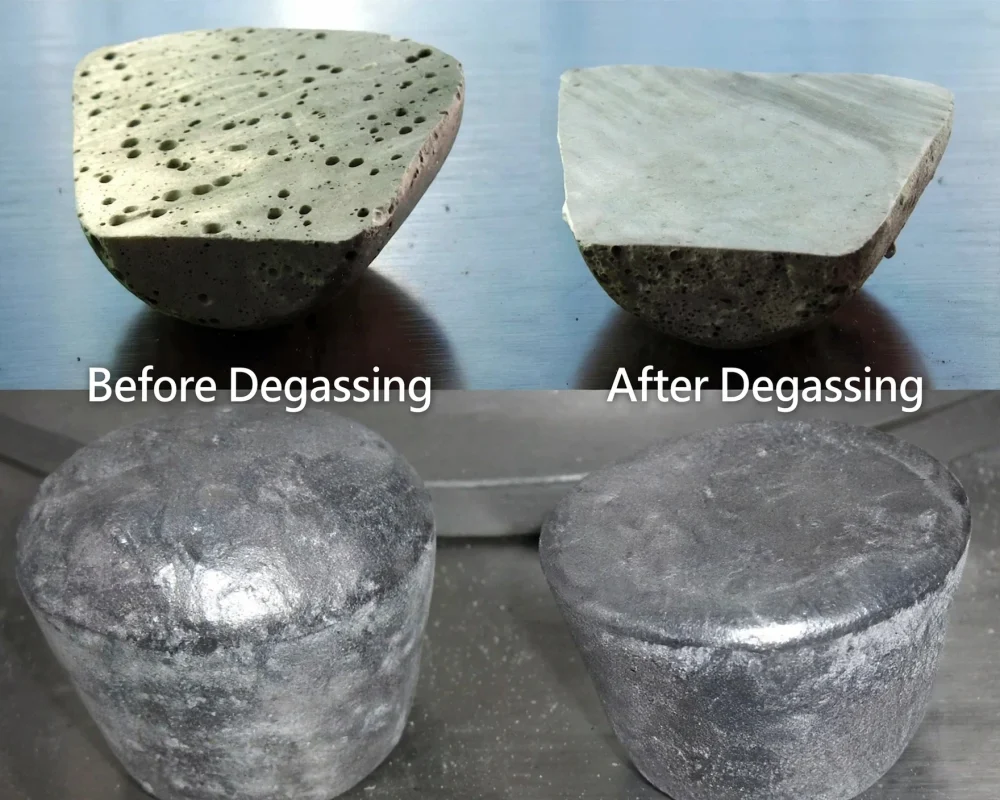
hydrogen in aluminum casting
How Does the Aluminum Degassing Process Work?
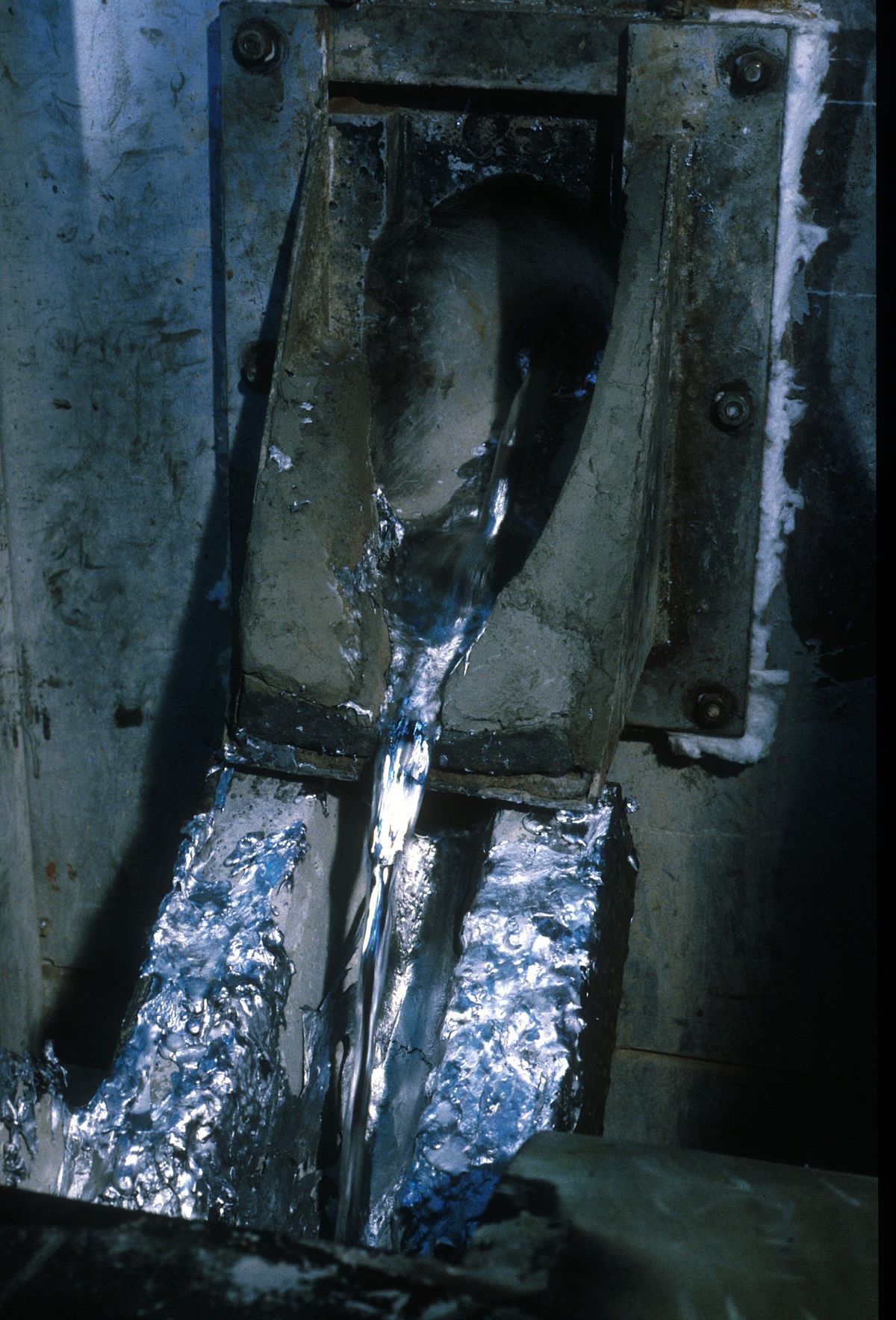
The basic principle is simple: a purge gas is introduced into molten aluminum to provide bubbles into which dissolved hydrogen can transfer.
1. Prepare the molten aluminum
The melt should be kept at an appropriate temperature and protected from unnecessary exposure to moisture and air. Clean and dry charge materials, tools, and equipment also help reduce hydrogen pickup.
2. Introduce the purge gas
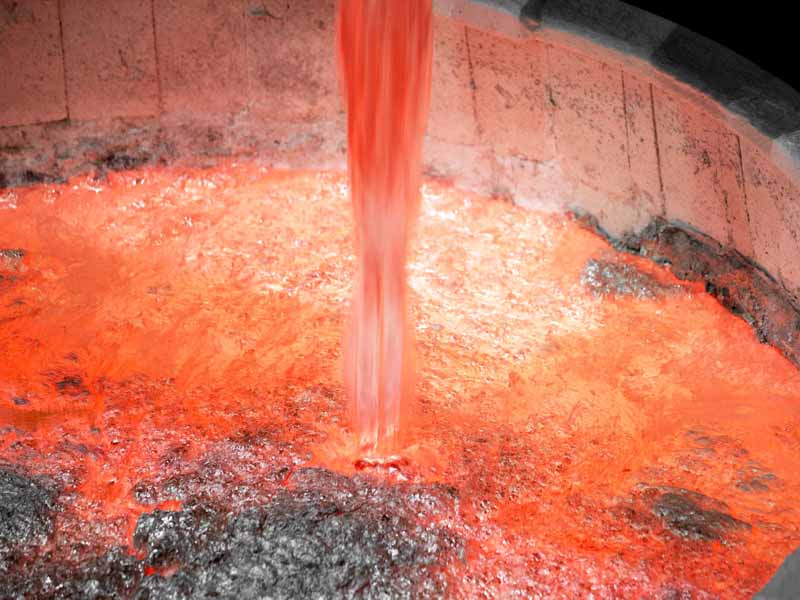
Nitrogen or argon is injected into the molten aluminum through a graphite lance, porous plug, nozzle, or rotating impeller.
3. Disperse the gas into the melt
The injected gas forms bubbles inside the molten aluminum. Smaller and more uniformly distributed bubbles provide greater gas-metal contact than large, poorly dispersed bubbles.
4. Remove dissolved hydrogen
Dissolved hydrogen transfers from the molten aluminum into the purge-gas bubbles. As the bubbles rise toward the surface, they carry the hydrogen out of the melt.
Nitrogen does not need to chemically react with hydrogen for this process to work. The primary mechanism is physical mass transfer: dissolved hydrogen moves from the molten aluminum into the purge-gas bubbles and is removed from the melt.
Why Are Nitrogen and Argon Used for Aluminum Degassing?
Nitrogen and argon are commonly used as purge gases because they are sufficiently inert under normal aluminum melt treatment conditions.
النيتروجين is widely used because it is readily available and economical for many aluminum casting applications.
الأرجون can also be used when a high-purity inert gas is preferred or when the process specification calls for it.
The appropriate gas depends on the alloy, melt quality requirements, equipment configuration, gas purity, and operating cost.
What Equipment Is Used for Aluminum Degassing?
Different aluminum casting operations use different gas-injection methods.
Graphite Lance
A graphite lance can inject purge gas directly into the molten aluminum. It is relatively simple and can be suitable for small-scale or occasional melt treatment.
However, treatment consistency depends strongly on lance position, gas flow, immersion depth, treatment time, and operator practice.
Porous Plug or Nozzle
Gas can also be introduced through porous plugs or nozzles installed in the furnace or treatment vessel. These systems can provide more defined gas injection locations.
وحدة إزالة الغازات الدوارة
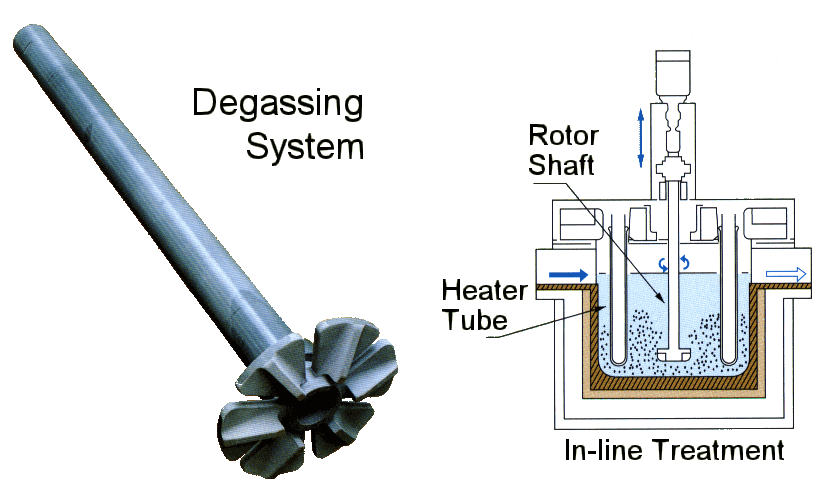
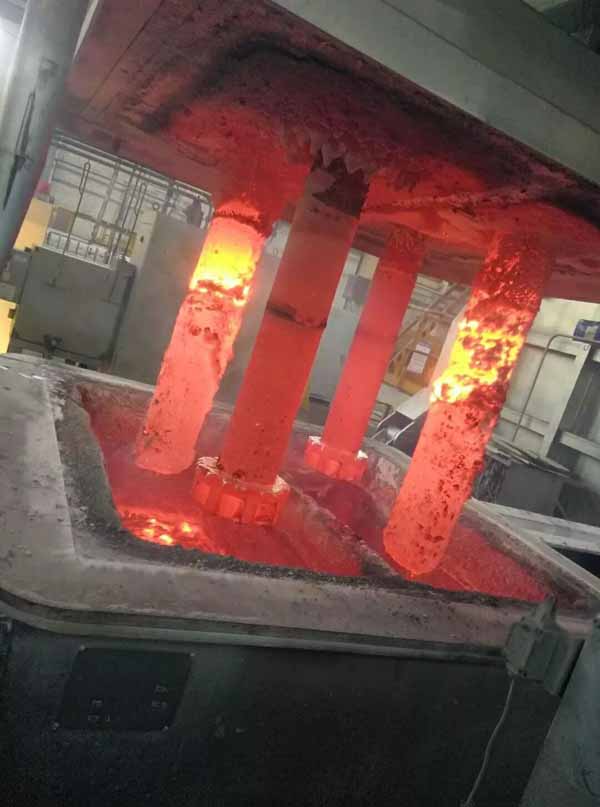
A rotary degassing unit uses a rotating rotor to disperse inert gas into fine bubbles throughout the molten aluminum.
Compared with simple lance bubbling, rotary treatment can provide more controlled bubble dispersion and stronger gas-metal contact. This makes it suitable for production environments where consistent melt quality is important.
وحدة إزالة الغازات عبر الإنترنت
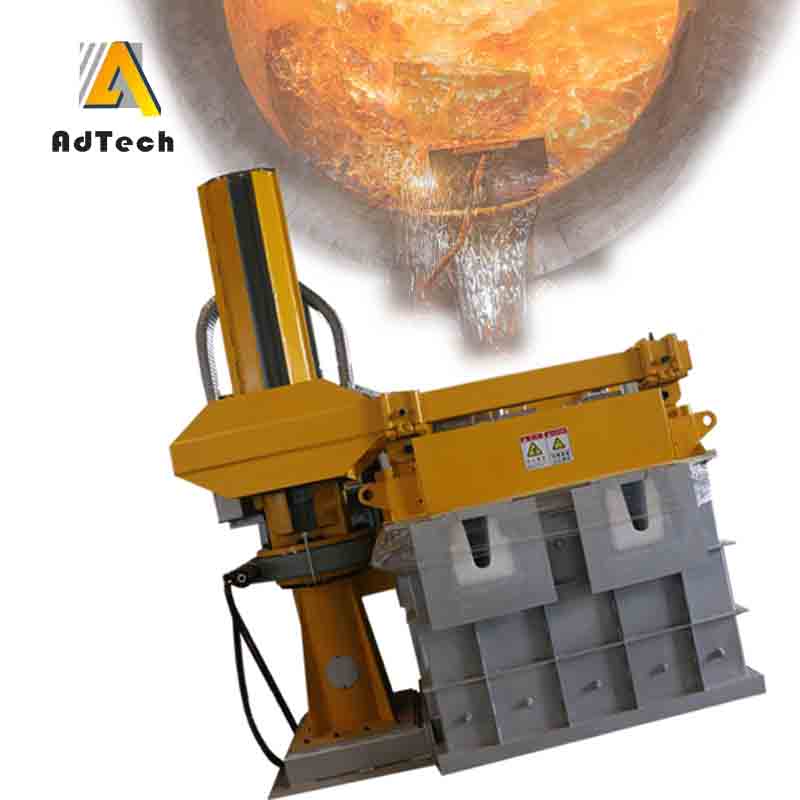
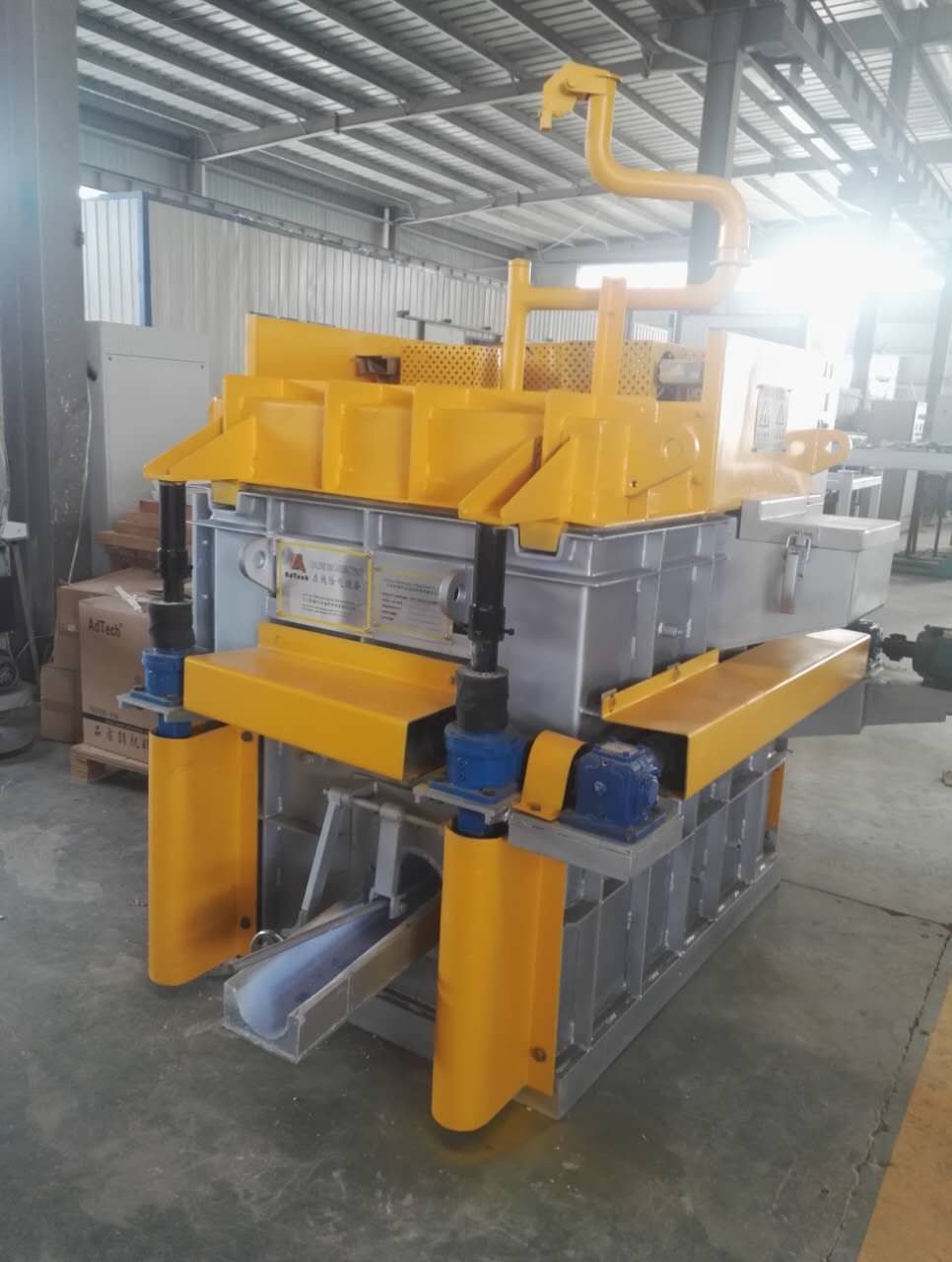
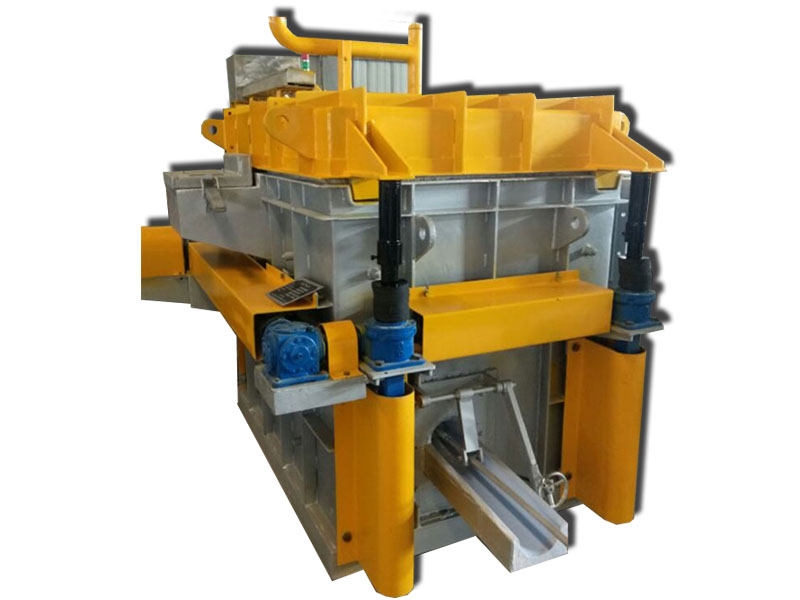
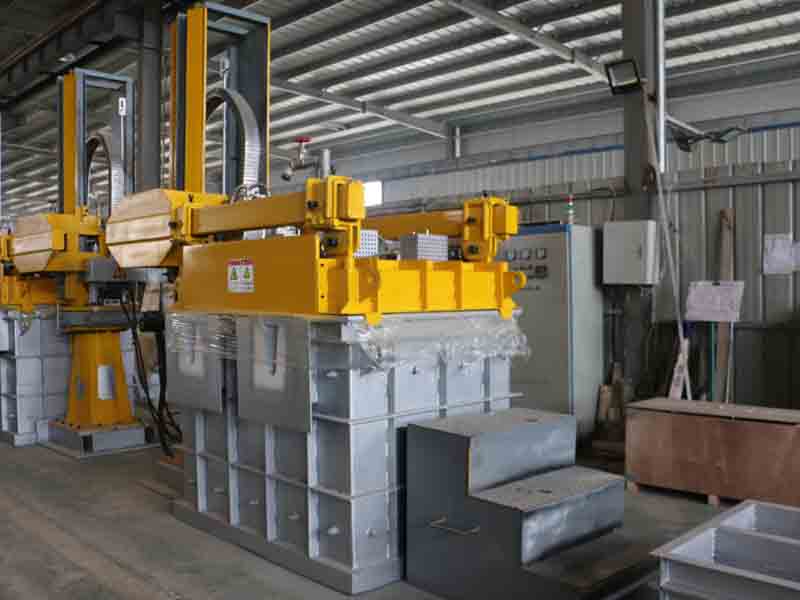
و وحدة إزالة الغازات عبر الإنترنت treats molten aluminum continuously as it flows through the casting system.
This configuration is particularly useful for continuous casting operations because the melt can be treated immediately before filtration and casting, reducing the need for manual batch treatment.
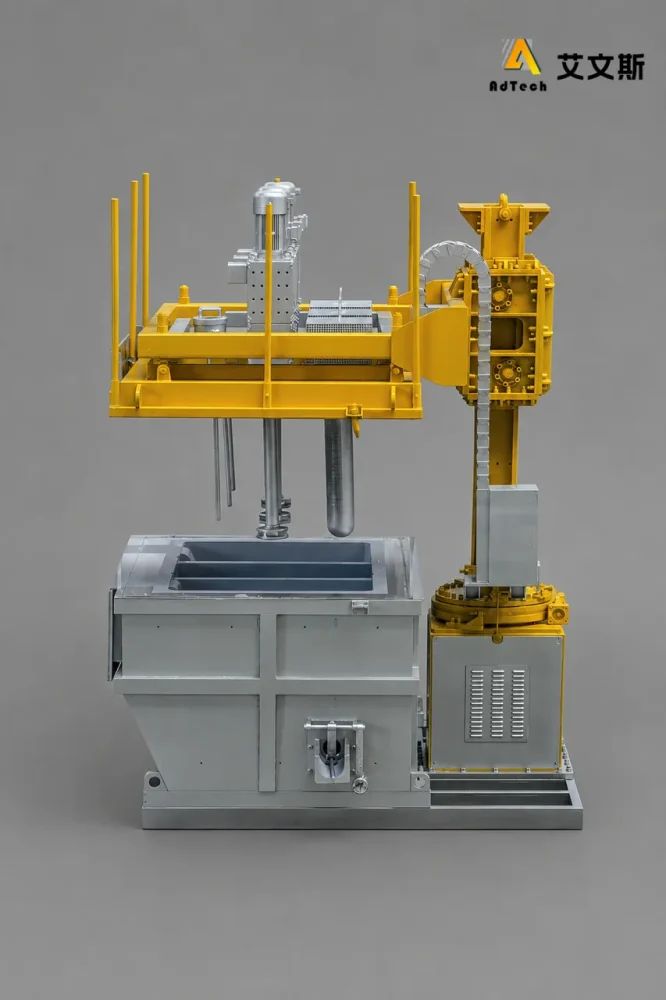
AdTech Online Degassing Aluminum Machine
What Is the Difference Between Lance Degassing and Rotary Degassing?
The main difference is how effectively the purge gas is dispersed through the melt.
| Factor | Lance Degassing | Rotary Degassing |
|---|---|---|
| Gas dispersion | Relatively simple | Fine and distributed |
| التشغيل | Manual or semi-manual | More controlled |
| Treatment consistency | Depends more on operator | More repeatable |
| Typical application | Small-scale or occasional treatment | Industrial production |
| Process control | More limited | Better control |
For production lines with strict melt-quality requirements, rotary degassing generally provides better process consistency than basic manual lance treatment.
Does Aluminum Degassing Remove Inclusions?
Degassing and filtration have different primary functions.
Aluminum degassing is mainly used to reduce dissolved hydrogen. Ceramic foam filters and other filtration systems are used to remove solid non-metallic inclusions, including oxide films and particles.
Rotary treatment may promote some inclusion flotation by improving melt circulation, but it should not be considered a replacement for an effective filtration system.
For high-quality aluminum casting, degassing and filtration are often used together:
Melting → Alloy Adjustment → Degassing → Filtration → Casting
The exact sequence can vary according to the casting process and plant configuration.
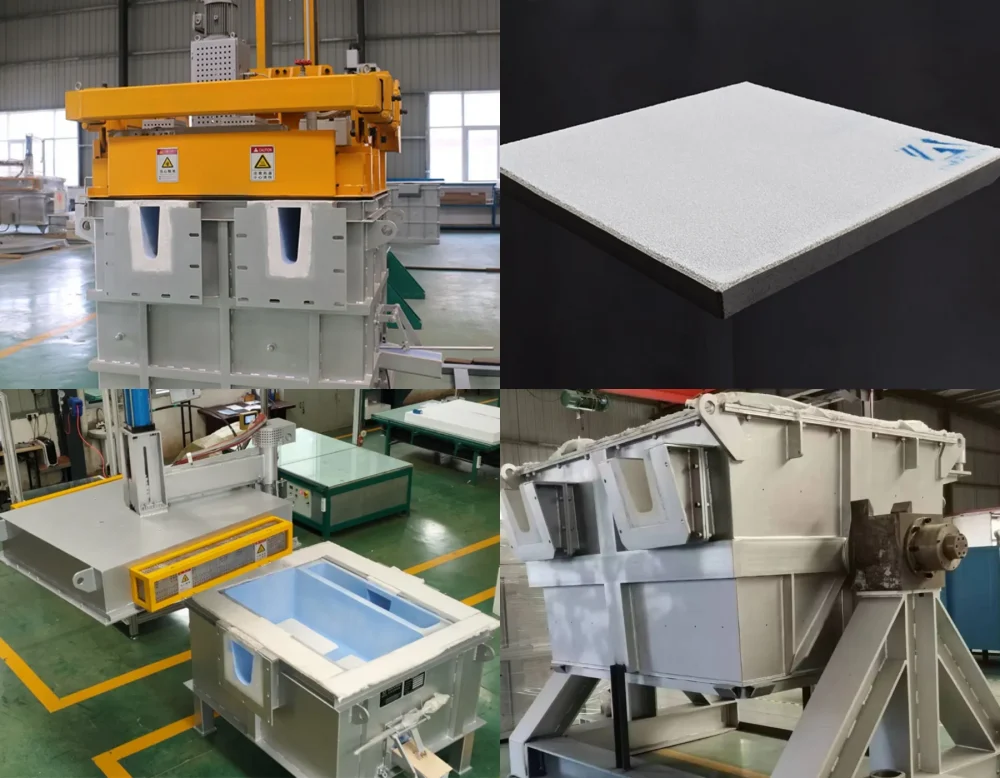
aluminum degassing and filtration equipment
What Factors Affect Aluminum Degassing Efficiency?
The effectiveness of an aluminum degassing process depends on more than simply injecting gas into the melt.
Important factors include:
- Purge gas flow rate
- Rotor speed
- Bubble size and distribution
- Treatment time
- Melt temperature
- Initial hydrogen concentration
- Rotor immersion depth
- Melt depth and circulation
- Gas purity and dryness
- Furnace and melt-handling practices
Excessive gas flow is not automatically better. Poorly controlled treatment can create large bubbles, excessive surface turbulence, oxide formation, or unnecessary melt loss.
The goal is to achieve effective gas dispersion while keeping the molten surface as stable as practical.
Can Aluminum Degassing Prevent Gas Porosity?
Proper degassing can significantly reduce the risk of hydrogen-related gas porosity, but it cannot guarantee completely pore-free castings.
Final casting porosity can also be affected by:
- Hydrogen concentration
- Alloy composition
- Oxide films
- Solidification conditions
- Casting temperature
- معدل التبريد
- Mold and casting design
- Melt handling practices
Therefore, degassing should be treated as one part of an overall molten aluminum quality-control process rather than a single solution for every casting defect.
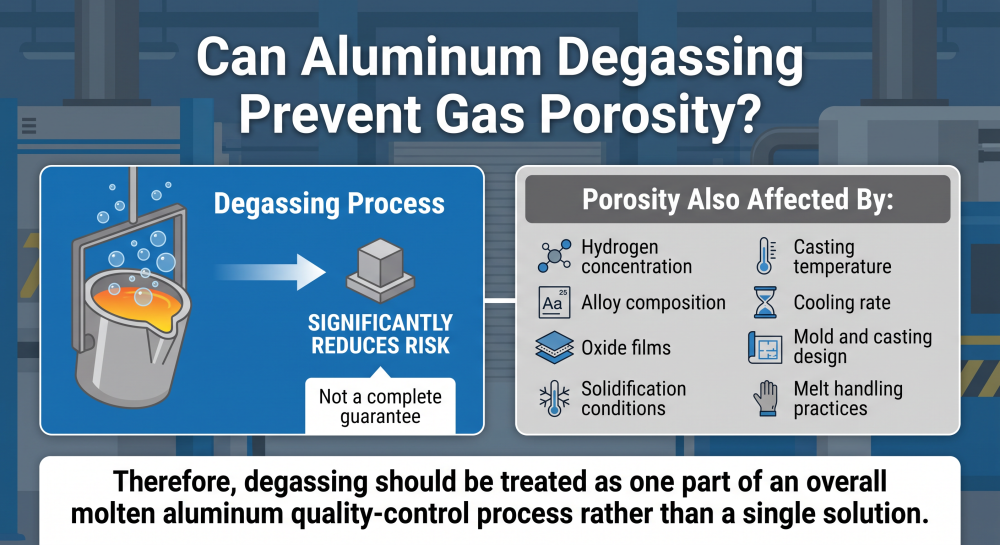
can aluminum degassing prevent gas porosity
When Should Molten Aluminum Be Degassed?
Degassing is commonly performed after melting and alloy adjustment and before the molten aluminum enters the casting process.
The exact treatment position depends on the furnace arrangement and casting line. In continuous production, an online degassing system can continuously treat the molten aluminum as it moves toward the casting machine.
Treatment should also be performed with appropriate attention to melt temperature, holding time, and cleanliness. Long holding times or unnecessary overheating can increase the opportunity for hydrogen pickup and oxidation.
Aluminum Degassing Process vs. Flux Treatment
Degassing and flux treatment are not interchangeable.
Inert-gas degassing primarily targets dissolved hydrogen. Fluxes are formulated for different refining functions, which may include oxide/inclusion treatment, slag separation, covering, or removal of specific impurities depending on the formulation.
The correct treatment depends on the actual melt-quality problem.
For example:
- High dissolved hydrogen: consider degassing.
- Non-metallic inclusions: use appropriate filtration and refining practices.
- Excess dross or slag: appropriate flux treatment may be required.
- Multiple melt-quality issues: a combination of treatments may be necessary.
How Can Aluminum Producers Improve Degassing Results?
Good degassing starts before the degassing equipment is switched on.
Producers should:
- Keep charge materials and tools dry.
- Avoid unnecessary melt holding.
- Maintain a suitable melt temperature.
- Use clean and dry purge gas.
- Control gas flow and rotor speed.
- Ensure proper rotor immersion and positioning.
- Avoid excessive surface turbulence.
- Combine degassing with effective molten-metal filtration.
- Monitor hydrogen levels when the casting application requires tight control.
Consistent operating conditions are often more important than simply increasing treatment time or gas flow.
الخلاصة
الـ aluminum degassing process is primarily used to reduce dissolved hydrogen in molten aluminum before casting. Nitrogen or argon is introduced into the melt through a lance, porous plug, or rotating impeller, allowing dissolved hydrogen to transfer into the gas bubbles and leave the melt.
For industrial aluminum casting, rotary and online degassing systems provide more controlled and repeatable gas dispersion than simple manual lance treatment. However, degassing alone does not remove every type of melt impurity. Combining effective hydrogen removal with proper filtration, temperature control, clean charge materials, and good melt-handling practices provides a more reliable approach to molten aluminum quality.
الأسئلة الشائعة
1. What is the aluminum degassing process?
The aluminum degassing process removes dissolved hydrogen from molten aluminum by introducing nitrogen or argon bubbles into the melt.
2. Why is degassing important in aluminum casting?
Degassing reduces dissolved hydrogen and helps lower the risk of hydrogen-related gas porosity during solidification.
3. Which gas is used for aluminum degassing?
Nitrogen and argon are commonly used as purge gases for molten aluminum degassing.
4. How does nitrogen remove hydrogen from molten aluminum?
Nitrogen forms bubbles in the melt, allowing dissolved hydrogen to transfer into the bubbles and leave the molten aluminum as they rise to the surface.
5. Does aluminum degassing remove inclusions?
Degassing primarily removes dissolved hydrogen. Ceramic foam filters and other filtration systems are mainly used to remove non-metallic inclusions.
6. What equipment is used for aluminum degassing?
Common methods include graphite lances, porous plugs, gas-injection systems, rotary degassing units, and online degassing units.
7. What is the difference between lance and rotary degassing?
Lance degassing is relatively simple but depends more on operator control, while rotary degassing provides finer and more uniform gas dispersion for more consistent treatment.
8. Can degassing completely prevent porosity in aluminum castings?
No. Proper degassing can significantly reduce hydrogen-related porosity, but casting porosity is also affected by alloy composition, oxide films, solidification conditions, and casting practices.
9. When should molten aluminum be degassed?
Degassing is commonly performed after melting and alloy adjustment and before casting. The exact treatment position depends on the casting process and furnace configuration.
10. What factors affect aluminum degassing efficiency?
Gas flow rate, rotor speed, bubble size, treatment time, melt temperature, gas purity, rotor immersion depth, and the initial hydrogen level all affect degassing performance.
مقالات ذات صلة:
 عملية إزالة الغازات
 عملية إزالة الغازات من الألومنيوم
 عملية إزالة الغازات من الألومنيوم في إندونيسيا
 إزالة الغازات من الألومنيوم
 شراء آلة إزالة الغازات من شركة Adtech China
 إزالة الغازات من الألومنيوم
 المعرفة في مجال الصب - إزالة الغازات من الألومنيوم 2
 عملية إزالة الغازات من الألومنيوم في عملية الصب
إزالة الغازات من الألومنيوم عبر الإنترنت
عملية إزالة الغازات من الألومنيوم في عملية الصب
إزالة الغازات من الألومنيوم عبر الإنترنت
 إزالة الغازات من سبائك الألومنيوم أثناء الصب المستمر باستخدام غاز الأرجون
 إزالة الغازات من الألومنيوم السائل
 أخبار ريو تينتو ألكان: آلة إزالة الغازات من الألومنيوم
 آلة إزالة الغازات من السبائك
 عملية إزالة الغازات من السبك
Sorry, the comment form is closed at this time.