
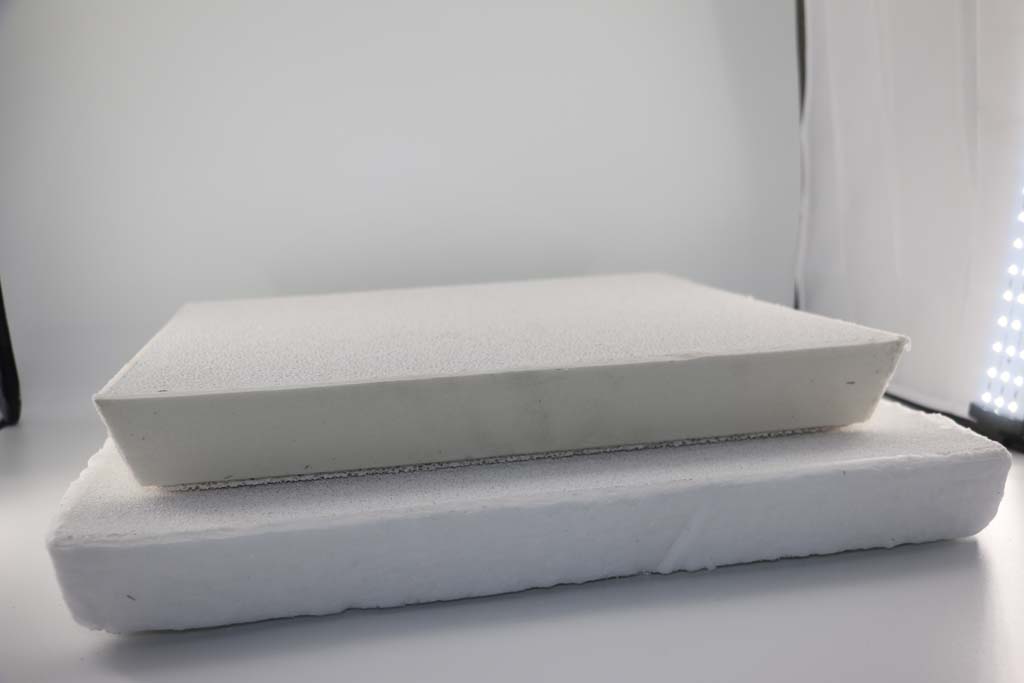
17 Mar Ceramic Foam Filter For Casting(CFF)
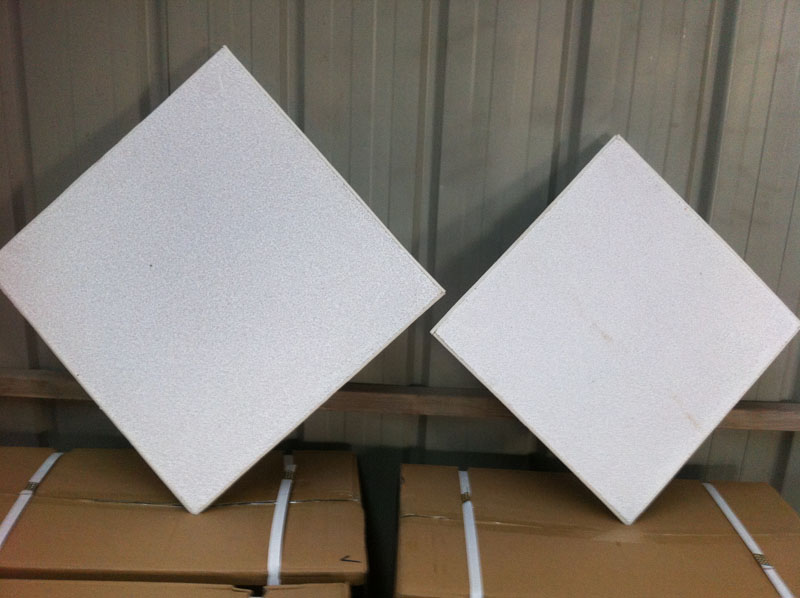
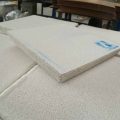
Ceramic Foam Filter For Casting
General Description of Ceramic Foam Filters
Ceramic filter foams is just developed as a new type molten metal filters to decrease casting flaw in recent years, play a vital role in the metal casting and foundry industries, where they are used to filter out impurities in molten metal to improve the quality and performance of the end product.
Even the slightest non-metal impurities in molten metal can have a devastating effect on the performance and strength of finished metal goods. This can result in end products failing to meet the necessary quality standards; Ceramic filters play an essential role in removing these impurities and ensuring high-quality casting.
Application of Ceramic Foam Filters
1.Decontaminated the molten metal liquid.
2.Simplified gating system.
3.Improve the metallurgical structure of the castings.
4.Reduce slag inclusions of the castings.
5.Increase the casting quality rate.
6.Reduce casting internal re-oxidation defects.
7.Reduce the surface defects after machining of the castings.
Advantage of Ceramic Foam Filters
1.High strength without loose ceramic particles or powder.
2.Three dimensional connected mesh structure and high porosity.
3.Large surface area of slag collection, large inner surface area of filtering.
4.Excellent thermal shock resistance.
5.Various sizes, shapes and pore sizes are available.
6.Particles larger than the pore size are captured at the top of the ceramic foam filter.
7.Smaller particles are captured on the filter cake created by the larger particles.
8.Finer particles are captured within the pores in the filter.
Ceramic foam filter Dimension
660x660x50(26 inch)
584x584x50(23 inch)
508x508x50(20 inch)
432x432x50(17 inch)
381x381x50(15 inch)
305x305x50(12 inch)
228x228x50(9 inch)
178x178x50(7 inch)
Ceramic foam filter Pore Size(PPI):10/20/30/40/50/60
Package of Ceramic Foam Filters
Individual carton package per filter, and then load in big carton or plywood case according to different size.
For package details, please contact our sales for more info.
Read more: How To Make Ceramic Foam Filter?
What Is a Ceramic Foam Filter and Why Does Molten Metal Need It?
A ceramic foam filter is a porous, three-dimensional ceramic structure manufactured by coating a polyurethane foam template with ceramic slurry, then firing the piece at high temperature to burn out the organic foam and sinter the ceramic into a rigid, reticulated skeleton. What remains is a lightweight block riddled with interconnected pores that force liquid metal to travel through a tortuous path rather than a straight line.
We’ve explained this to plant managers many times: raw molten metal, whether it’s A356 aluminum or ductile iron, carries suspended particles. These include oxide films, slag, refractory erosion particles, sand grains dislodged during pouring, and intermetallic compounds. If these contaminants reach the mold, they become hard spots, leak paths, or crack initiation sites in the finished part. Machine shops downstream will reject parts with these defects, and warranty failures on structural or pressure-tight components can cost far more than the casting itself.
The filter works through three separate mechanisms happening simultaneously. First, mechanical straining physically blocks particles larger than the pore openings. Second, the tortuous internal geometry causes turbulent flow to settle into laminar flow, which allows smaller particles to drop out by gravity or adhere to the ceramic walls (a phenomenon foundry engineers call “deep bed filtration”). Third, the ceramic surface itself has a chemical affinity for oxide films, causing them to stick to the pore walls rather than pass through with the metal stream.
We’ve watched this process on plant floors using high-speed cameras, and the flow-smoothing effect is often more valuable to final casting quality than the straining effect alone. A turbulent metal stream entering a mold entrains air and creates new oxide films on the spot; a filter that calms the flow prevents this secondary contamination from ever forming.
What Materials Are Ceramic Foam Filters Made From and Which One Fits Your Alloy?
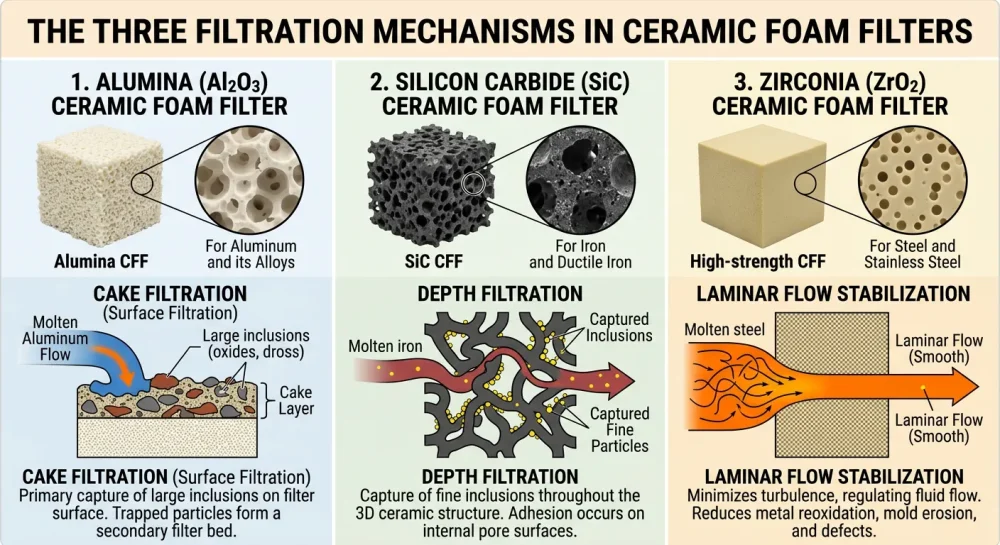
THE THREE FILTRATION MECHANISMS IN CERAMIC FOAM FILTERS
Not every ceramic works for every metal. Chemical compatibility between the filter material and the molten alloy determines whether the filter survives the pour without dissolving, cracking, or contaminating the melt with its own particles.
| Filter Material | Typical Composition | Best Suited For | Max Service Temp | Notes |
|---|---|---|---|---|
| Alumina (Al2O3) | 45-90% Al2O3 | Aluminum, aluminum alloys | Up to 1450°C | Most common, cost-effective, widely stocked |
| Zirconia (ZrO2) | Zirconia-mullite blend | Steel, high-nickel alloys | Up to 1700°C | Higher thermal shock resistance, pricier |
| Silicon Carbide (SiC) | SiC with oxide bonding | Gray iron, ductile iron | Up to 1600°C | Excellent thermal conductivity, chemically stable in iron |
| Mullite | Aluminosilicate | Copper alloys, bronze | Up to 1500°C | Good resistance to copper-based slag attack |
We’ve had customers try to save money by running an alumina filter on gray iron because it was cheaper per piece than silicon carbide. The result was filter dissolution mid-pour, which contaminated an entire heat and cost roughly forty times what the correct filter would have cost. Material selection is not a place to cut corners, and any reputable supplier will tell you this upfront rather than sell you whatever’s in stock.
Zirconia filters deserve special mention because they’ve become the standard choice for steel casting operations over the past fifteen years. Steel’s pouring temperature (typically 1550-1650°C) puts enormous thermal stress on ceramic structures, and zirconia’s superior thermal shock resistance prevents the cracking that plagued earlier alumina-based steel filters.
How Many Pore Density Options Exist and How Do You Pick the Right One?
Pore density, measured in pores per linear inch (PPI), is probably the single most misunderstood specification in ceramic foam filter selection. We get calls weekly from purchasing agents who ordered the wrong PPI simply because nobody explained the tradeoff between filtration fineness and flow rate.
| PPI Rating | Pore Size (approx.) | Flow Rate | Filtration Efficiency | Typical Application |
|---|---|---|---|---|
| 10 PPI | 2.5-3.0mm | Very High | Coarse particles only | Large castings, high fill-rate risers |
| 20 PPI | 1.5-2.0mm | High | Medium-coarse | General aluminum sand castings |
| 30 PPI | 1.0-1.3mm | Medium-High | Medium | Automotive components, wheels |
| 40 PPI | 0.7-0.9mm | Medium | Fine | Precision aluminum castings |
| 50 PPI | 0.5-0.6mm | Low-Medium | Very fine | Thin-wall, high-integrity castings |
| 60-80 PPI | 0.3-0.5mm | Low | Ultra-fine | Aerospace, critical structural parts |
Choosing too fine a PPI for a large casting section causes premature filter clogging, and the metal front can freeze inside the runner system before the mold fills completely. We’ve seen this cause complete pour failures on large iron castings where an inexperienced buyer specified 50 PPI on a part that needed 20 PPI.
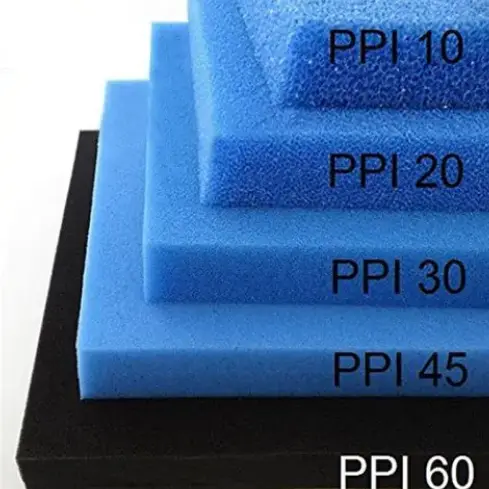
10–60 PPI filter foam contrast
Conversely, choosing too coarse a PPI on a thin-wall precision part means small inclusions pass straight through, and the casting fails X-ray inspection or pressure testing downstream. Our general rule, developed through years of trial runs with customers, is to match PPI to the thinnest wall section of the casting and the total pour weight together, not either factor alone.
How Does Filter Size Relate to Pour Weight?
Filter surface area needs to scale with total metal volume passing through it, not just pore density. A filter that’s correctly sized for fineness but too small in surface area will clog regardless of PPI rating.
| Pour Weight Range | Recommended Filter Size (approx.) | Filter Print Area |
|---|---|---|
| Under 10 kg | 50mm x 50mm | 20-25 cm² |
| 10-30 kg | 75mm x 75mm | 45-55 cm² |
| 30-80 kg | 100mm x 100mm | 80-95 cm² |
| 80-200 kg | 150mm x 150mm | 180-200 cm² |
| Over 200 kg | 200mm x 200mm or multiple filters | 350+ cm² |
We always recommend running a trial pour when moving to a new part geometry rather than trusting a chart alone, because gating design and pour speed both shift the effective flow demand on the filter.
What Shapes Are Available and Where Does Each Shape Get Used?
Ceramic foam filters aren’t limited to a single geometry. Foundries choose shape based on the gating system design and how the filter integrates into the mold or filter print.
Square filters remain the most widely produced shape because they fit standard filter print cavities used across the sand casting industry. Most aluminum foundries running high-volume automotive parts default to square filters simply due to tooling standardization.
Round filters show up more often in gravity die casting and some investment casting applications where the sprue system is circular by design. They’re also common in ductile iron foundries using vertical gating.
Rectangular filters get specified when the gating system has a wide, shallow cross-section, often in large flat castings like engine blocks or transmission housings where metal needs to spread across a wide runner before entering the mold.
Bonded filter assemblies, where two or more filters are joined into a single unit, handle extremely high pour volumes in large steel or iron castings, distributing flow across a wider filtration surface without redesigning the entire gating system.
How Do Ceramic Foam Filters Compare to Other Filtration Technologies?
Foundries have several filtration options, and we think it’s worth being honest about where ceramic foam filters genuinely outperform alternatives and where they don’t.
| Filter Type | Filtration Efficiency | Cost | Flow Rate Control | Best Application |
|---|---|---|---|---|
| Ceramic Foam Filter | High | Moderate | Excellent | General purpose, most alloys |
| Extruded Ceramic (cellular) | Medium | Low | Good | Budget aluminum casting |
| Woven Fiberglass Cloth | Medium-Low | Very Low | Poor | Low-value, low-integrity parts |
| Bonded Fiber Filters | Medium | Low | Fair | Small volume aluminum |
| Ceramic Tube Filters | High | High | Excellent | Steel, continuous casting |
Extruded ceramic filters, sometimes called honeycomb filters, are cheaper but have straight-through channels rather than the tortuous foam structure. This means they rely almost entirely on mechanical straining and offer no deep-bed filtration benefit. We generally steer customers away from these unless budget constraints are severe and part criticality is low.
Fiberglass cloth filters catch large particles but do nothing for oxide films or fine inclusions, and they can shed glass fibers into the melt in some cases. We rarely recommend them for anything beyond non-critical decorative castings.
What Manufacturing Standards and Specifications Should You Verify Before Buying?
We’ve noticed that procurement teams often focus entirely on price per piece and skip verification of manufacturing quality, which causes problems later. A few specifications matter more than others when you’re evaluating a supplier.
Compressive strength determines whether the filter survives handling, insertion into the filter print, and the hydrostatic pressure of the metal head during pour. Industry-acceptable ranges typically run between 0.8 MPa and 2.5 MPa depending on filter material and PPI, with finer PPI filters generally needing higher compressive strength to avoid crushing.
Thermal shock resistance matters because the filter goes from room temperature to over 700°C (aluminum) or over 1500°C (iron/steel) within seconds of metal contact. A filter with poor thermal shock resistance will crack on contact, sending ceramic fragments straight into the casting, which is arguably worse than having no filter at all.
Dimensional tolerance affects whether the filter seats correctly in the filter print without gaps that allow unfiltered metal to bypass the filter entirely. We ask suppliers for tolerance data in writing, typically expecting +/- 0.5mm on standard sizes.
Porosity uniformity across the filter face prevents localized high-flow channels that reduce overall filtration effectiveness. Reputable manufacturers perform batch testing and can provide test certificates on request; if a supplier can’t produce this documentation, we consider that a warning sign.
| Specification | Typical Acceptable Range | Testing Method |
|---|---|---|
| Compressive strength | 0.8-2.5 MPa | ASTM C695 or equivalent |
| Bulk density | 0.4-0.9 g/cm³ | Archimedes method |
| Porosity | 75-90% | Volumetric displacement |
| Max service temperature | 1450-1750°C (material dependent) | Manufacturer thermal test |
| Dimensional tolerance | ±0.5mm | Caliper measurement |
How Should Ceramic Foam Filters Be Installed and Handled on the Foundry Floor?
We’ve spent enough time on production floors to know that even a perfectly manufactured filter fails if it’s handled incorrectly. A few practices separate foundries that get consistent results from those that struggle with unexplained defect rates.
Filters need to be preheated before metal contact in most operations, especially for iron and steel casting. A cold filter absorbs heat from the initial metal stream, which can cause localized freezing right at the filter face and restrict flow for the remainder of the pour. Preheating to somewhere between 150°C and 300°C (depending on alloy and filter material) prevents this thermal shock issue and gets the filter thermally stable before the bulk of the metal arrives.
The filter must seat completely within the filter print cavity with no gaps around the edges. We’ve traced numerous customer defect complaints back to a filter that shifted slightly during mold assembly, opening a bypass channel along one edge that let unfiltered metal straight through. Some foundries now use a thin ceramic fiber gasket around the filter perimeter to guarantee a complete seal.
Storage conditions before use matter more than people assume. Ceramic foam filters absorb ambient moisture over time, and pouring metal onto a damp filter causes a steam explosion inside the pore structure, which can crack the filter or, worse, cause a violent metal splash. We recommend storing filters in a dry, climate-controlled area and running a low-temperature bake-out cycle if filters have been stored for extended periods or in humid conditions.
Pour rate control matters too. Pouring too fast overwhelms the filter’s flow capacity and causes turbulent overflow around the filter print, defeating the purpose of filtration entirely. Pouring too slow allows the metal front within the filter to cool and partially freeze, restricting flow for the remainder of the pour. Foundries running consistent pour rates through trained operators or automated pouring systems get noticeably better filter performance than those with variable manual pouring.
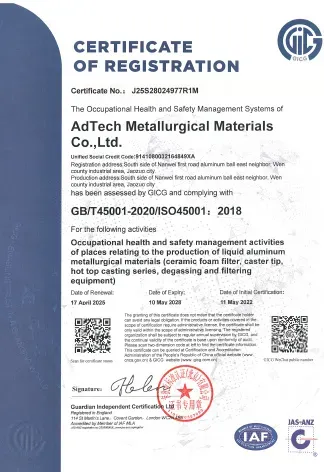
AdTech ceramic foam filter quality certification certificate
What Problems Commonly Occur and How Can They Be Diagnosed?
Every foundry we’ve worked with eventually runs into one of these issues. Recognizing the symptom quickly saves scrapped heats.
| Problem | Likely Cause | Solution |
|---|---|---|
| Filter clogs before pour completes | PPI too fine for pour weight, or filter too small | Increase filter size or reduce PPI |
| Metal freezes in gating system | Filter not preheated, pour rate too slow | Preheat filter, increase pour rate |
| Ceramic fragments in casting | Thermal shock cracking, wrong material for alloy | Switch to correct material, verify preheat |
| Unfiltered metal bypass visible in casting | Poor filter seating, gap around edges | Improve mold assembly, use sealing gasket |
| Inconsistent casting quality across batches | Supplier inconsistency, batch-to-batch porosity variance | Request QC certificates, audit supplier |
| Filter dissolves partially into melt | Chemical incompatibility with alloy | Reassess material selection per compatibility chart |
| Excessive turbulence downstream of filter | Filter too coarse relative to gating velocity | Reduce PPI selection error, redesign gating |
We keep this table posted in more than one client’s quality office because these seven issues cover roughly 90% of the filter-related complaints we field in a given year.
How Do You Evaluate and Choose a Ceramic Foam Filter Supplier?
This is where our procurement background comes in useful, because buying decisions on this product often go wrong for reasons that have nothing to do with the filter itself.
We tell buyers to ask suppliers for a certificate of analysis on every batch, not just the first sample order. Foam-based ceramic manufacturing has natural batch variance, and a supplier confident in their process will provide this without hesitation. If a supplier hedges or delays on documentation requests, that’s worth noting.
Lead time consistency matters more than headline price in most cases. A filter that’s 10% cheaper but arrives two weeks late during a production ramp-up costs far more in downtime than the unit savings. We’ve seen buyers chase the lowest quoted price and then scramble when the supplier’s actual delivery performance didn’t match the sales promise.
Minimum order quantities vary enormously between manufacturers, and this affects working capital tied up in inventory. Smaller job shop foundries should look for suppliers willing to work with lower MOQs even at a modest price premium, rather than overstocking a filter size that might change with the next tooling revision.
Technical support availability separates commodity suppliers from partners. When we’ve had unusual casting defects that might trace back to filtration, the suppliers who send an engineer to review the process (rather than just shipping replacement product) are the ones worth building a long-term relationship with.
| Evaluation Criteria | Why It Matters | Red Flag to Watch For |
|---|---|---|
| QC documentation | Confirms batch consistency | Reluctance to share certificates |
| Delivery reliability | Prevents production downtime | Vague or shifting lead time quotes |
| Material traceability | Needed for aerospace/automotive audits | No raw material sourcing info |
| Technical support | Helps solve defect root causes | Sales-only contact, no engineering access |
| Price stability | Affects budget planning | Frequent unexplained price changes |
What Does Ceramic Foam Filter Cost Structure Look Like and What’s the Real ROI?
Pricing on ceramic foam filters varies by material, size, and PPI, but we can offer general ranges based on current market conditions across multiple regions we’ve sourced from.
| Filter Type | Approximate Price Range (per piece, standard sizes) |
|---|---|
| Alumina, 20-30 PPI, small (50-75mm) | $0.80 – $2.50 |
| Alumina, 20-30 PPI, medium (100-150mm) | $2.50 – $6.00 |
| Silicon Carbide, iron applications | $3.00 – $9.00 |
| Zirconia, steel applications | $8.00 – $25.00 |
| Large bonded assemblies | $30.00 – $150.00+ |
These figures shift with raw material costs (particularly zirconium and silicon carbide feedstock pricing) and order volume, but they give a working baseline for budgeting.
The ROI calculation we walk clients through focuses on scrap reduction rather than filter cost alone. If a foundry runs 1,000 castings monthly at $50 average value per piece, and filtration reduces scrap rate from 8% to 3%, that’s 50 fewer scrapped castings monthly, worth $2,500. Against a filter cost increase of perhaps $500-800 monthly for the upgrade to correct PPI or material, the payback is immediate and recurring every month thereafter. We’ve run this exact calculation for clients switching from cloth filters to properly specified ceramic foam filters, and the numbers consistently justify the switch within the first month of production.
Frequently Asked Questions
1. Can a ceramic foam filter be reused after one casting cycle?
No. Ceramic foam filters are single-use consumables. The pore structure becomes loaded with trapped inclusions during the first pour, and attempting reuse would either restrict flow severely or release previously trapped contaminants back into a new melt.
2. What causes a ceramic foam filter to crack during pouring?
Thermal shock is the primary cause, usually from an unpreheated filter meeting molten metal at full pouring temperature. Material mismatch (using alumina in an application requiring higher thermal shock resistance) and physical damage during handling before installation also contribute.
3. How long can ceramic foam filters be stored before use?
Most manufacturers rate shelf life at 12-24 months when stored in dry, climate-controlled conditions. Beyond that timeframe, moisture absorption becomes a real risk, and we recommend a bake-out cycle for any filter stored longer than six months in less-than-ideal warehouse conditions.
4. Does filter PPI affect casting surface finish?
Indirectly, yes. Finer PPI filters remove smaller inclusions and produce calmer metal flow, both of which reduce the likelihood of surface defects like cold shuts or inclusion-related pitting. However, PPI alone doesn’t control surface finish; gating design and mold coating play equally large roles.
5. Can one filter type work across aluminum, iron, and steel?
No single material performs optimally across all three. Alumina works well for aluminum but degrades in iron and steel service temperatures. Silicon carbide suits iron. Zirconia handles steel’s higher thermal demands. Using a mismatched filter risks contamination and structural failure of the filter itself mid-pour.
6. What’s the difference between a filter print and the filter itself?
The filter print is the cavity molded into the sand mold or die that holds the ceramic foam filter in position during pour. The filter itself is the ceramic component. Filter print dimensions must match filter dimensions closely to avoid bypass gaps.
7. Do ceramic foam filters affect metal chemistry?
A correctly matched filter has negligible chemical interaction with the melt. A mismatched filter, however, can dissolve partially and introduce ceramic contamination into the alloy, which is why material compatibility verification matters before any large production run.
8. Is preheating always necessary?
For iron and steel casting, preheating is standard practice and strongly recommended. For lower-temperature aluminum casting, some foundries skip preheating successfully, though we still recommend it for larger filters or high-volume pours where thermal shock risk increases with filter mass.
9. How do I know if my current filter PPI is wrong for my process?
Signs of PPI mismatch include frequent premature freezing (PPI too fine), visible inclusions in finished castings despite filtration (PPI too coarse), or inconsistent fill times across supposedly identical pours (filter sizing or PPI variance). Running a controlled trial with adjacent PPI grades usually identifies the correct specification within two or three test batches.
10. What documentation should I request from a ceramic foam filter supplier?
At minimum, request material composition data, compressive strength test results, maximum service temperature ratings, and batch-specific quality certificates. For aerospace or automotive-grade production, also request full material traceability records and any third-party certification the supplier holds.
Related posts:
 ceramic foam filters in the foundry
 Ceramic foam filter for casting industry
 Ceramic foam filter for casting factory to enhance casting product quality
 Aluminium Alloy Ceramic Foam Filters For Casting
 For Aluminium Casting Filtration
Types of Ceramic Foam Filters Used In Casting
For Aluminium Casting Filtration
Types of Ceramic Foam Filters Used In Casting
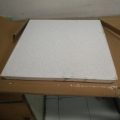 Melt Aluminum Foam Ceramic Filter
Ceramic foam filter for Casting Industry
Reference parameter on the use of foam filters.
Melt Aluminum Foam Ceramic Filter
Ceramic foam filter for Casting Industry
Reference parameter on the use of foam filters.
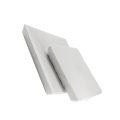 Zro2 Foam Ceramic Filter
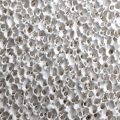 Ceramic foam filter for casting aluminum
 Foam Ceramic Filter For Casting Filtration
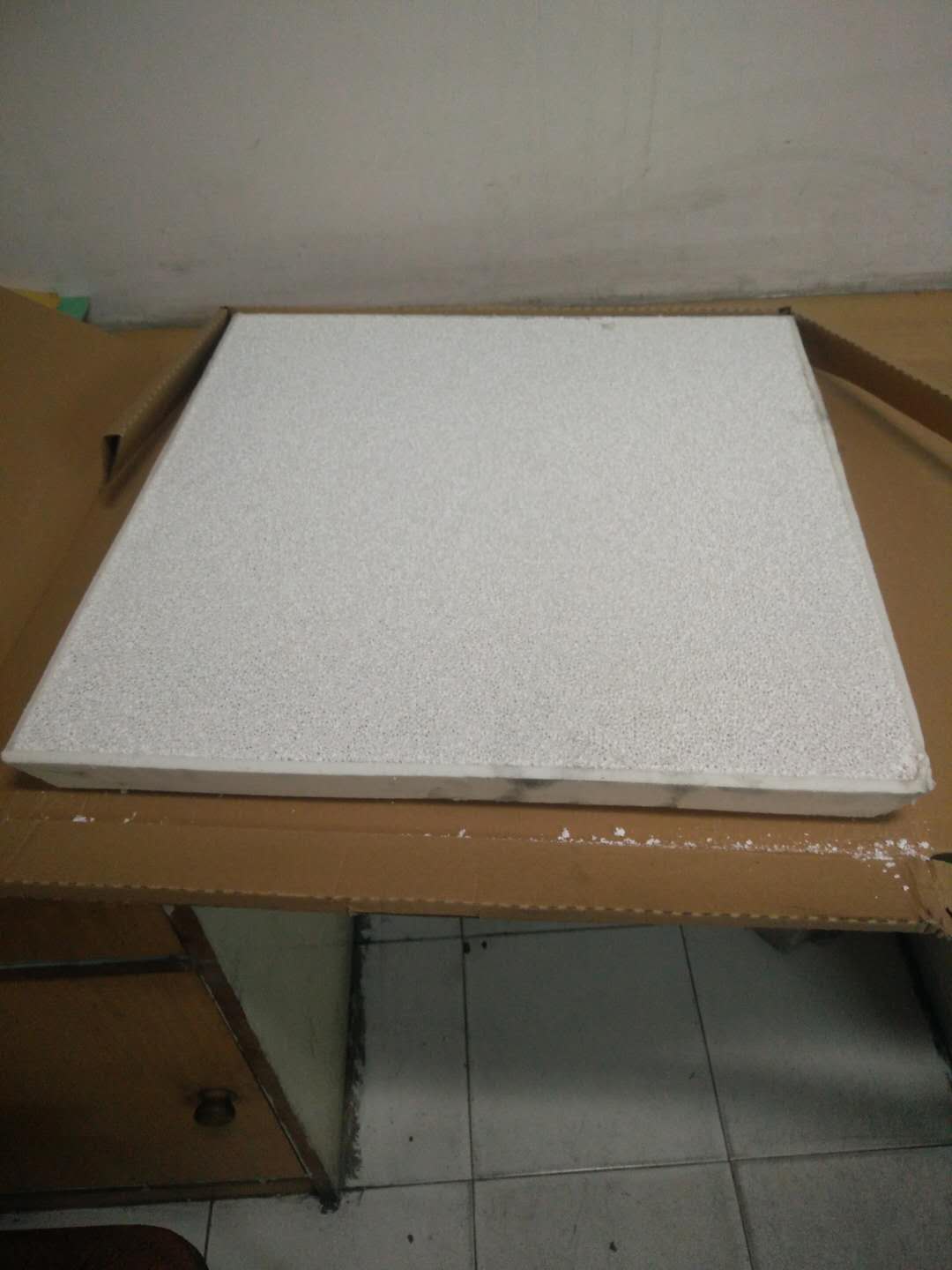 Ceramic Foam Filter Used In Metallurgy And Casting
 Ceramic Foam Filter For Casting
No Comments