
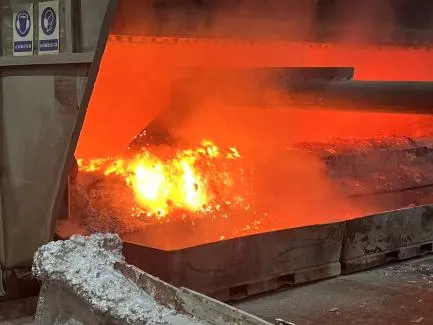
22 يناير كيفية تقليل خبث الألومنيوم المنصهر
How to Reduce Molten Aluminum Dross
When melting aluminum, oxidation is unavoidable. Contact between molten aluminum and air produces an oxide film, and part of this oxide layer can become aluminum dross during melting, transfer, pouring, and stirring. However, “reduce” can mean two different things: reducing the amount of dross generated, or recovering metallic aluminum from dross that has already formed. These are not the same process.
In this article, molten aluminum dross reduction refers primarily to reducing aluminum loss and recovering metallic aluminum from dross, while also looking at practical ways to limit unnecessary dross formation during production.
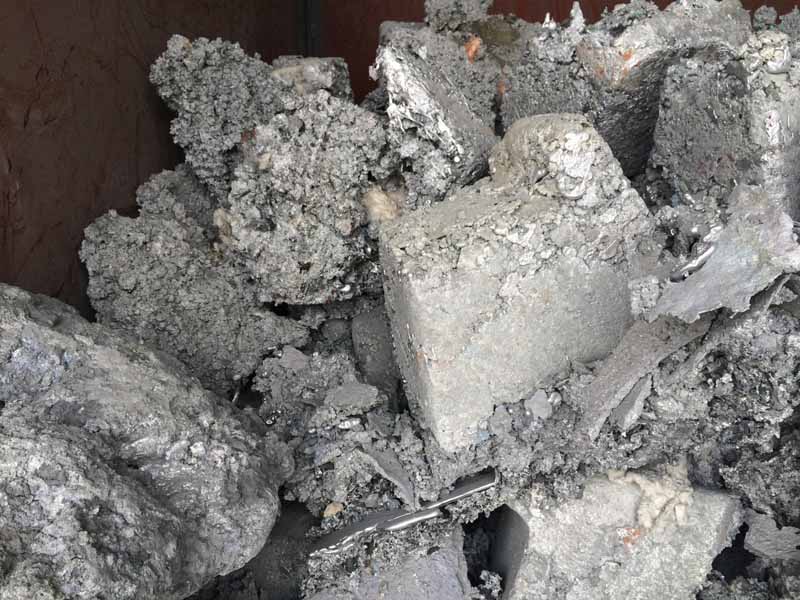
What Is Aluminum Dross Made Of?
Aluminum dross is not simply aluminum oxide.
Fresh dross can contain:
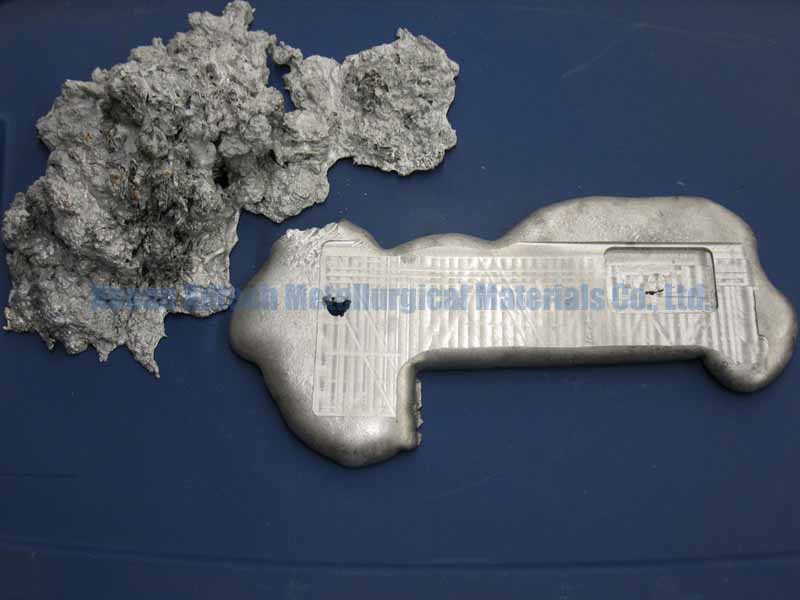
- Metallic aluminum trapped between oxide particles
- Aluminum oxide and other oxidation products
- Flux or salt residues, depending on the process
- Other impurities and inclusions
The amount of metallic aluminum in dross can vary considerably depending on the alloy, furnace operation, temperature, transfer method, stirring intensity, and dross-removal practice.
This distinction is important because the aluminum that can normally be recovered from dross is primarily metallic aluminum already present in the dross. It is different from chemically converting aluminum oxide back into metallic aluminum.
Can Aluminum Oxide in Dross Be Reduced Back to Aluminum?
Not simply by adding a conventional refining agent to the molten aluminum.
Aluminum oxide (Al₂O₃) is a very stable oxide. In normal aluminum melting and holding operations, the practical objective is generally not to chemically convert Al₂O₃ back into metallic aluminum, but to prevent excessive oxidation and recover the metallic aluminum that has become entrained in the dross.
Industrial aluminum production uses electrolysis to produce primary aluminum from alumina. Therefore, it would be misleading to describe ordinary aluminum refining flux as a chemical method for converting Al₂O₃ in dross directly back into aluminum metal.
For an aluminum plant, there are therefore two practical approaches:
- Reduce the amount of metallic aluminum lost into dross during melting.
- Recover the metallic aluminum already contained in dross after it is removed from the furnace.
Why Does Molten Aluminum Produce Dross?
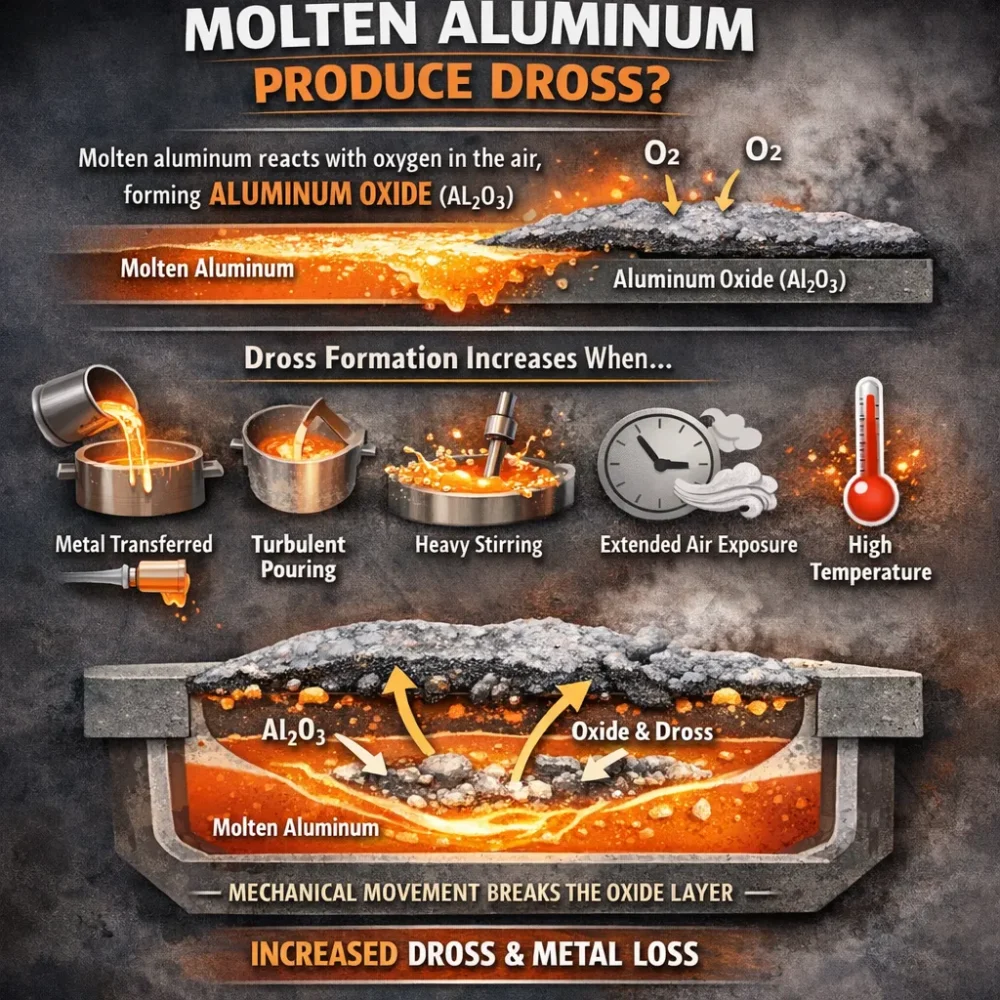
Why does molten Aluminum Produce Dross?
The main cause is the reaction between hot molten aluminum and oxygen in the surrounding atmosphere.
A freshly exposed molten aluminum surface rapidly develops an oxide film. Under stable conditions, this film can provide some protection to the underlying metal. However, production operations continuously disturb the molten surface.
Dross generation can increase when molten aluminum is:
- Transferred between furnaces or vessels
- Dropped from one level to another
- Poured or charged turbulently
- Stirred aggressively
- Exposed to air for extended periods
- Held at unnecessarily high temperatures
Mechanical movement is particularly important. When the oxide film is repeatedly broken and folded into the melt, oxide can become mixed with small quantities of metallic aluminum. This increases both dross formation and metal loss.
How Can You Reduce Aluminum Loss During Melting?
There is no practical way to eliminate aluminum dross completely. The goal is to avoid unnecessary oxidation and minimize the amount of metallic aluminum carried away with the dross.
1. Use a Reasonable Melting and Holding Temperature
Higher temperatures generally accelerate oxidation and can increase aluminum loss when molten metal remains exposed to the atmosphere.
The furnace should therefore operate at a temperature appropriate for the alloy and casting process rather than maintaining unnecessarily high temperatures.
The objective is not simply to use the lowest possible temperature. The melt still needs sufficient temperature for melting, alloying, transfer, treatment, and casting. Instead, avoid excessive superheat and unnecessary holding.
2. Shorten Unnecessary Holding and Transfer Time
The longer molten aluminum remains exposed to air, the greater the opportunity for oxidation.
Long holding times can therefore contribute to additional oxide formation, particularly when the melt surface is frequently disturbed.
Good production planning can help:
- Avoid unnecessary furnace holding
- Coordinate melting with downstream casting
- Minimize repeated transfers
- Reduce waiting time between melt treatment and casting
Reducing unnecessary exposure time can lower both oxidation and energy consumption.
3. Reduce Turbulence During Molten Aluminum Transfer
Molten aluminum should not be handled more violently than necessary.
When aluminum falls from one level to another or enters another vessel with excessive turbulence, the surface oxide film can break apart and become folded into the melt. This can increase the amount of oxide and metallic aluminum entering the dross.
A well-designed transfer and launder system should therefore aim for smooth, controlled molten-metal flow rather than unnecessary splashing or free-falling metal.
4. Control Stirring Intensity
Stirring is often necessary for alloy homogenization and melt treatment, but excessive agitation can increase contact between molten aluminum and the atmosphere.
Mechanical stirring or gas injection should therefore be controlled according to the actual process requirement.
The important point is not to eliminate stirring, but to achieve the required mixing and treatment effect without creating unnecessary surface turbulence.
5. Improve the Charging Sequence
Charging practice also affects oxidation.
Large drops, excessive movement of scrap, and unnecessary disturbance of the molten surface can increase oxide formation. A controlled charging sequence can reduce the amount of molten aluminum exposed to air and limit mechanical disturbance.
The optimum sequence depends on the furnace design, charge material, alloy and production cycle, so it should be established according to the actual melting operation rather than following one universal rule.
6. Avoid Unnecessary Disturbance of the Oxide Layer
An oxide film on the surface of molten aluminum can provide a degree of protection from further atmospheric exposure.
Repeatedly breaking, folding, or mechanically disturbing this layer can increase oxide formation and entrain metallic aluminum.
For this reason, dross should be removed using an appropriate procedure rather than excessive agitation of the melt surface.
Can Refining Flux Help Reduce Aluminum Loss?
Refining flux and dross reduction are related, but they should not be treated as the same operation.
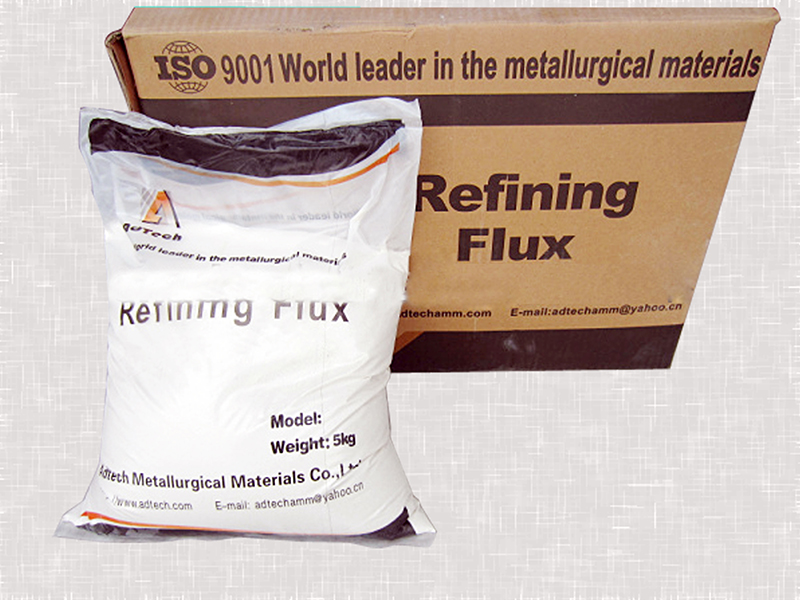
Aluminum Refining Flux is primarily used for molten-metal treatment. Depending on the formulation and application, refining flux can help remove impurities, non-metallic inclusions and dissolved hydrogen, while improving the cleanliness of molten aluminum.
However, refining flux should not be described as a simple chemical agent that converts Al₂O₃ back into metallic aluminum.
Its role is better understood as part of the overall molten aluminum treatment process. Proper melt treatment, combined with good temperature control and careful handling, can contribute to better melt quality and more controlled dross formation.
Learn More About Our Refining Flux
How Do You Recover Aluminum From Dross?
Once dross has already been removed from the furnace, the objective changes.
At this stage, the question is no longer primarily:
How do we prevent oxidation?
It becomes:
How much metallic aluminum remains in the dross, and how can it be recovered?
Dross processing methods are designed to separate metallic aluminum from the oxide-rich portion of the dross. Depending on the plant and dross characteristics, this can involve mechanical, thermal, pressing, or other separation processes.
The appropriate recovery method depends on factors such as:
- Metallic aluminum content
- Dross temperature
- Dross quantity
- Alloy type
- Furnace and casting operation
- Required recovery rate
- Plant throughput and available equipment
A plant producing large quantities of dross may therefore evaluate dross-processing equipment based on its actual metal recovery potential rather than simply treating dross as waste.
Is Aluminum Dross Waste?
Not necessarily.
Aluminum dross contains valuable metallic aluminum, which is why it can have significant recovery value. After metallic aluminum is separated, the remaining oxide-rich material may also have potential uses depending on its composition and local handling requirements.
For an aluminum producer, the better approach is to look at dross as a material-loss and recovery problem, rather than simply a waste-disposal problem.
A useful way to think about the overall process is:
Prevent unnecessary oxidation → minimize metal entrainment → recover metallic aluminum from dross → manage the remaining dross responsibly.
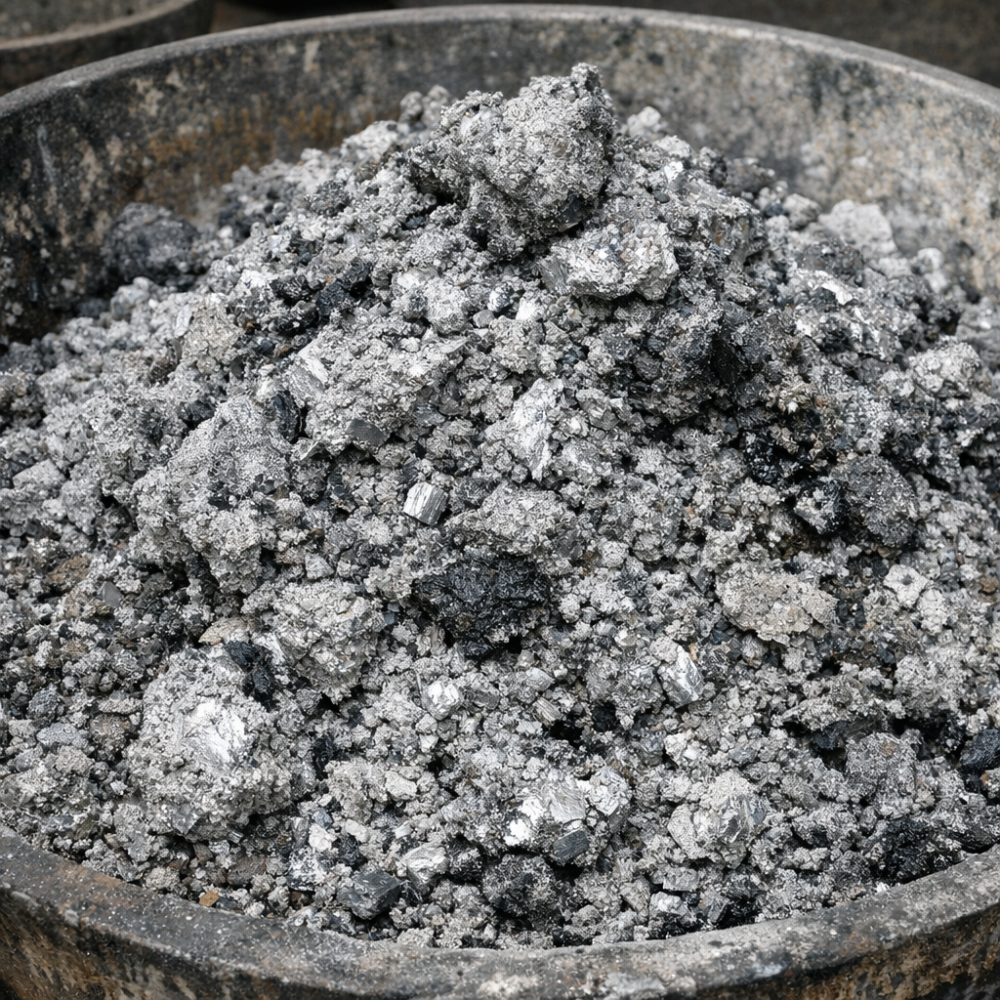
خبث الألومنيوم
What Is the Most Effective Way to Reduce Aluminum Loss?
There is no single product or operating adjustment that eliminates aluminum loss.
The best results normally come from controlling several stages of the process together:
| Process factor | Main risk | Practical approach |
|---|---|---|
| Melting temperature | Excessive oxidation | Use an appropriate process temperature |
| Holding time | Longer air exposure | Avoid unnecessary holding |
| Molten-metal transfer | Oxide entrainment and splashing | Maintain controlled flow |
| Stirring | Surface disturbance | Use controlled stirring intensity |
| Charging | Oxidation and turbulence | Optimize charging practice |
| Surface management | Repeated oxide-film disruption | Minimize unnecessary disturbance |
| Dross handling | Loss of metallic aluminum | Use an appropriate recovery method |
| Melt treatment | Hydrogen and inclusions | Apply suitable refining treatment |
The key is to distinguish dross prevention من dross recovery.
Preventing unnecessary dross reduces the amount of aluminum that is lost from the melting process in the first place. Recovering aluminum from existing dross addresses the metal that has already been carried out of the furnace.
Final Takeaway
If by “reduce molten aluminum dross” you mean turning aluminum oxide back into metallic aluminum, conventional molten-metal refining should not be described that way. Aluminum oxide is a stable compound, and ordinary refining flux is not a direct substitute for the industrial processes used to produce metallic aluminum from alumina.
In practical aluminum production, the more useful strategy is to reduce aluminum loss at the source and recover metallic aluminum already trapped in the dross.
Good temperature control, shorter unnecessary holding times, smoother molten-metal transfer, controlled stirring, careful charging, and appropriate dross handling can all contribute to better aluminum recovery and lower metal loss.
Dross will always be part of aluminum melting. The goal is not to make its formation impossible, but to keep unnecessary dross generation and metallic aluminum loss under control.
الأسئلة الشائعة
1. Can aluminum dross be reduced back to aluminum?
Not directly. Aluminum oxide is very stable. In practice, metallic aluminum already trapped in the dross is recovered through dross processing and separation.
2. What causes aluminum dross to form?
Aluminum dross mainly forms when molten aluminum reacts with oxygen in the air. Turbulent transfer, stirring, pouring, and prolonged exposure can increase dross formation.
3. How can I reduce aluminum dross during melting?
Control the melting temperature, shorten unnecessary holding time, reduce turbulence during transfer, and avoid excessive stirring or disturbance of the molten aluminum surface.
4. Does higher melting temperature increase aluminum dross?
Generally, yes. Higher temperatures can accelerate oxidation and increase aluminum loss, especially when molten aluminum is held for long periods.
5. Does stirring increase aluminum dross?
Excessive stirring can increase oxidation by disturbing the oxide film and increasing the molten aluminum’s exposure to air. Stirring should be controlled according to the treatment requirement.
6. Can refining flux turn aluminum oxide into aluminum?
No. Refining flux is not a direct chemical method for converting Al₂O₃ into metallic aluminum. It is mainly used to treat molten aluminum by removing hydrogen, inclusions, and other impurities.
7. How do you recover aluminum from aluminum dross?
Dross processing equipment can separate metallic aluminum from the oxide-rich portion of the dross. The appropriate method depends on the dross composition, temperature, metal content, and processing volume.
8. Does aluminum dross contain metallic aluminum?
Yes. Fresh aluminum dross can contain a significant amount of metallic aluminum trapped between oxide particles, although the amount varies with operating conditions and dross handling.
9. Can aluminum dross be recycled?
Yes. Metallic aluminum can be recovered from dross, while the remaining oxide-rich material may be processed or reused depending on its composition and local requirements.
10. What is the best way to reduce aluminum loss from dross?
The most effective approach is to combine dross prevention with aluminum recovery: minimize unnecessary oxidation during melting and recover metallic aluminum from dross after it is removed.
مقالات ذات صلة:
 تقليل خسائر الصب في مصانع صب الألومنيوم
 أهم 5 أسئلة وأجوبة حول معالجة خبث الألومنيوم
 محطة تكرير الألومنيوم المنصهر
 مرشح للألمنيوم المنصهر
 فقدان الألومنيوم أثناء الصهر
 صهر الألومنيوم باستخدام تقنية «فلوكس»
 الألمنيوم المنصهر
 عملية صهر الألومنيوم
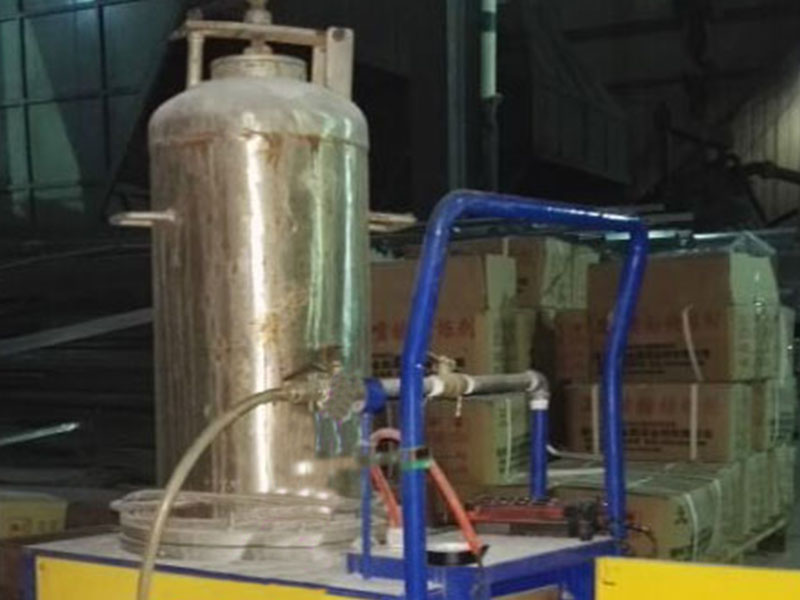 مغذي مادة التذويب في عملية صهر الألومنيوم
 مواد الصهر المستخدمة في مصانع صب الألومنيوم
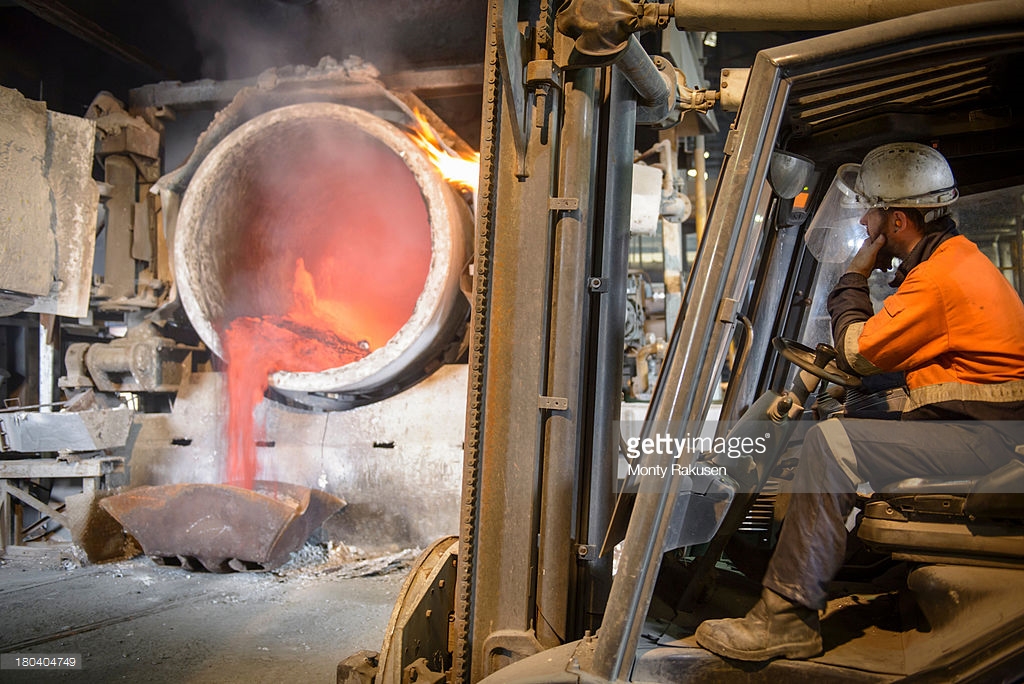 الألومنيوم السائل
 تكرير الألومنيوم المنصهر
 مخروط التثبيت لسبائك الألومنيوم
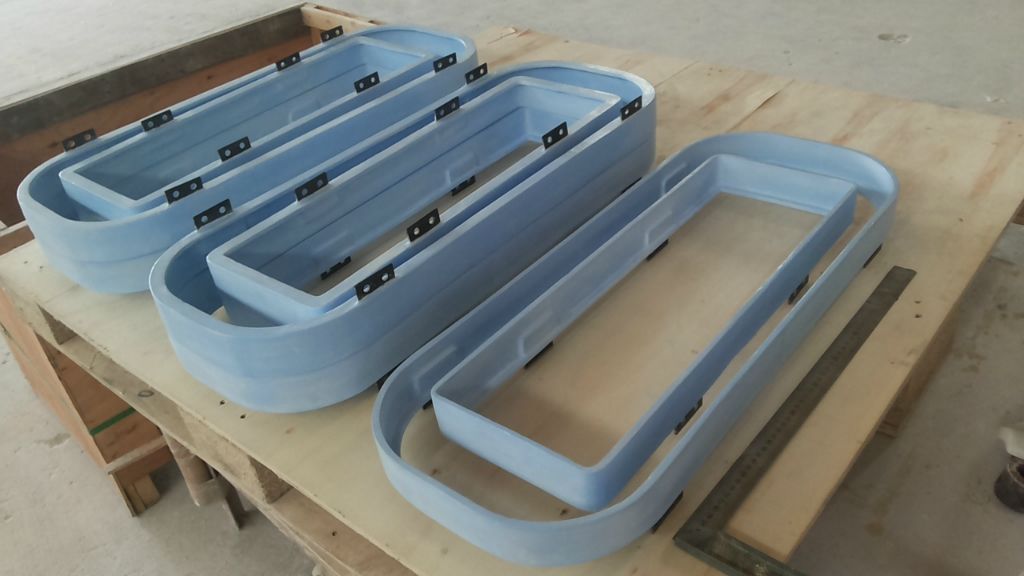 حلقة خبث صب الألومنيوم لآلة صب القضبان المعدنية، مخصصة لمعالجة خبث الألومنيوم
No Comments