
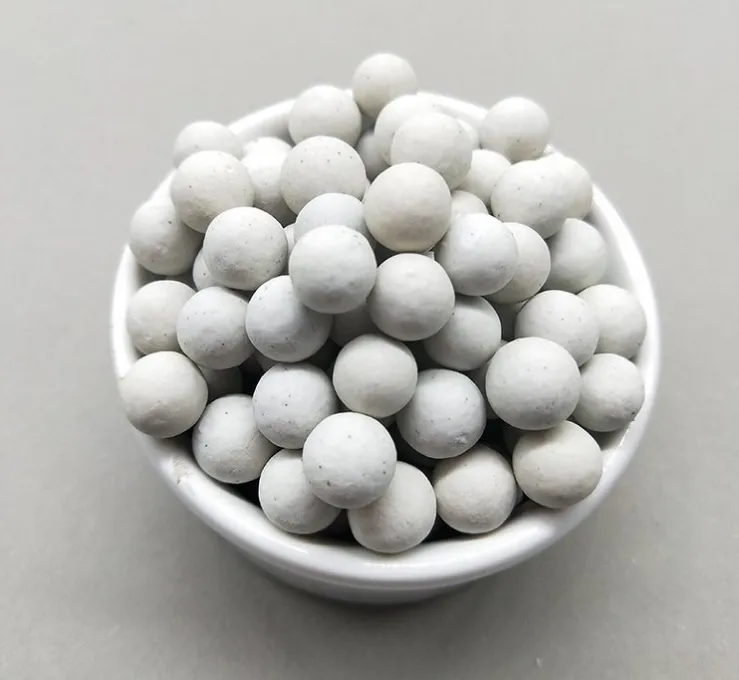
25 Mar Inert Alumina Ceramic Ball: Catalyst Bed Support Media, 99% Al2O3
Inert alumina ceramic balls are the industry-standard media for catalyst bed support, providing a stable, unreactive foundation for chemical reactions in high-pressure environments. Engineered from high-purity alumina, AdTech’s ceramic balls—available in 92% to 99.5% Al2O3—are specifically designed to withstand extreme thermal shock, high mechanical loads, and aggressive chemical corrosion.
As a specialized manufacturer, AdTech produces inert ceramic balls that serve as the support and covering material for catalysts in reactors, absorbers, and hydrocrackers. Our products ensure optimal gas and liquid distribution while protecting the underlying catalyst from migration or contamination, meeting the most rigorous standards of the global petrochemical and fertilizer industries.
Technical Highlights & Supply Capabilities:
-
Alumina Content: Available in 92%, 95%, and ultra-high 99% Al2O3 grades.
-
Mechanical Strength: Exceptional crush strength to support heavy catalyst loads without fracture.
-
Chemical Resistance: Outstanding resistance to strong acids, alkalis, and organic solvents.
-
Thermal Stability: Rated for continuous operation in high-temperature environments up to 1650℃.
-
Size Range: Comprehensive diameter options from 3mm to 50mm (1/8” to 2”) in stock.
-
Quality Standards: Fully compliant with industrial specifications for reactor internals with full MTC provided.
Inert Alumina Ceramic Ball
What is an inert alumina ceramic ball, and why is 99% Al2O3 catalyst bed support media so widely used?
An inert alumina ceramic ball is a high-temperature ceramic sphere made primarily from alumina, sintered into a dense, chemically stable support material. In process plants, these balls sit under catalyst, adsorbent, molecular sieve, or desiccant layers. Their main job is not catalytic reaction. Their job is mechanical support, flow conditioning, and protection of internals.
The term inert matters. It means the ball is designed to remain chemically passive under operating conditions rather than actively adsorbing moisture or participating in the process chemistry. This is a crucial distinction from activated alumina, which is porous and used as an adsorbent.
A 99% Al2O3 grade is valued because it offers:
- Higher chemical purity.
- Lower silica carryover risk.
- Better high-temperature stability.
- Stronger resistance in many corrosive environments.
- Lower contamination risk in sensitive catalyst systems.
- Better long-term dimensional integrity.
Quick definition table
| Term | Meaning in plant practice | Why it matters |
|---|---|---|
| Inert alumina ceramic ball | Dense ceramic sphere used as support media | Protects grid and supports catalyst layers |
| 99% Al2O3 | Very high alumina content, low impurity grade | Reduces contamination and improves thermal stability |
| Catalyst bed support media | Layer placed under active catalyst | Carries load and improves flow distribution |
| Bed grading | Use of multiple ball sizes in layers | Prevents migration and manages pressure drop |
| Top cover layer | Small upper support balls near catalyst bed | Holds catalyst and protects lower layers |
Across refinery and chemical process literature, the same selection logic appears repeatedly: once catalyst value rises and contamination sensitivity increases, higher-purity alumina support media becomes easier to justify.
How does a catalyst bed support media layer actually work inside a reactor?
A support media bed does much more than simply “hold up the catalyst.” In an operating vessel, the ceramic ball layer manages several interacting duties at the same time.
Core mechanical and hydraulic functions
- It transfers catalyst weight safely onto the support grid.
- It reduces point loading that could damage reactor internals.
- It creates a graded transition between large support openings and much smaller catalyst particles.
- It helps distribute liquid and gas across the reactor cross section.
- It limits catalyst loss through the support plate.
- It reduces localized channeling near the vessel bottom.
- It absorbs some thermal and mechanical stress during startup, shutdown, and process transients.
Why support balls protect expensive catalyst charges
Catalyst beds are rarely cheap. In hydroprocessing, reforming, sulfur recovery, syngas, and specialty chemical units, the catalyst inventory may represent a major shutdown cost. If the support system is weak, the consequences can include:
- Bed settling
- Screen deformation
- Catalyst leakage into lower plenum.
- Maldistribution
- Pressure drop drift.
- Hot spots
- Premature unit shutdown.
A properly designed support media layer reduces these risks.
Support function table
| Function | What the alumina balls do | Practical benefit |
|---|---|---|
| Load transfer | Spread bed weight over a larger area | Protects grid and vessel internals |
| Particle retention | Bridge the size difference between catalyst and support plate openings | Prevents catalyst escape |
| Flow conditioning | Smooth gas or liquid entry near the bottom | Improves bed utilization |
| Thermal buffering | Tolerate process heat and cycling | Improves reliability during startup and upset |
| Mechanical stabilization | Reduce bed movement under flow reversals or surges | Helps preserve catalyst geometry |
Why the lower bed region often determines reactor reliability
Many operating problems that appear “catalyst-related” actually begin at the support zone. If flow distribution entering the bed is uneven, active catalyst above cannot perform evenly. That is why experienced reactor designers pay close attention to the support media stack, not only the active catalyst specification.
Which material properties make 99% alumina balls superior in demanding chemical and petrochemical units?
When plant teams compare support balls, the headline figure is often alumina content. That is a useful start, yet the deeper engineering picture includes purity, phase structure, density, crushing strength, thermal shock resistance, and chemical stability.
Key properties that matter most
| Property | Why engineers care | Why buyers should care |
|---|---|---|
| Al2O3 content | Indicates purity and refractory stability | Higher purity often means lower contamination risk |
| Crushing strength | Reflects load-bearing ability | Reduces breakage and replacement frequency |
| Bulk density | Influences bed weight and packing behavior | Affects shipping, loading, and vessel calculations |
| Water absorption | Low values usually point to dense sintering | Lower risk of weakness and contamination |
| Acid resistance | Important in many chemical units | Protects service life |
| Alkali resistance | Relevant in selected process streams | Helps avoid early degradation |
| Thermal shock resistance | Important during startup and shutdown | Limits cracking during transients |
| Dimensional tolerance | Supports consistent bed packing | Improves installation quality |
Typical chemical composition range in high-purity support balls
Exact chemistry varies by grade and producer. The following table reflects common market expectations for premium 99% alumina support media.
| Component | Typical premium range |
|---|---|
| Al2O3 | 99.0% min |
| SiO2 | 0.2% to 0.8% |
| Fe2O3 | 0.05% to 0.3% |
| Na2O and other alkalis | Very low |
| CaO, MgO, TiO2, others | Trace level |
Low silica and low iron are especially important in catalyst systems that are sensitive to contamination or prolonged high-temperature service.
Why phase stability and sintering quality matter
A 99% alumina ball is valuable not simply because the chemistry says 99. It also needs dense, well-controlled sintering. Weak sintering can leave the ball vulnerable to:
- Surface spalling
- Crush failure under load.
- Higher dust generation.
- Thermal cracking.
- Moisture-related weakness during storage.
In other words, chemical purity without proper ceramic processing is not enough.
Why is 99% Al2O3 often chosen instead of 92%, 95%, or lower-purity ceramic support balls?
Not every unit needs 99% alumina. Many general applications use 92% or 95% grades successfully. The reason 99% media remains popular is that it offers a higher safety margin in sensitive, high-value, or aggressive service.
Comparison table by purity level
| Grade | Typical strengths | Typical limitations | Common use logic |
|---|---|---|---|
| 92% alumina | Cost-effective, good mechanical support in moderate service | Higher impurity content, lower chemical reserve in severe conditions | Budget-sensitive general support layers |
| 95% alumina | Balanced cost and performance | Still not ideal in highly contamination-sensitive duties | Many standard reactor support applications |
| 99% alumina | Very high purity, stronger chemical stability, lower silica contamination risk | Higher initial cost | Premium catalyst beds, critical process units, severe operating conditions |
| 99.5% and above | Ultra-high purity niche use | Cost rises significantly | Specialty systems requiring extreme contamination control |
When the premium is usually justified
A 99% grade often makes sense when:
- Catalyst inventory is expensive.
- The reactor runs at elevated temperature for long campaigns.
- Contamination limits are strict.
- Acidic or chemically aggressive conditions exist.
- Shutdown cost far exceeds support media cost.
- The process relies on stable flow distribution over a long cycle.
Why lower impurity content protects the catalyst system
Silica, alkalis, and other minor oxides can become important over long periods, especially in units with high temperature, steam, reactive feeds, or catalyst formulations sensitive to poisoning or unwanted side reactions. In those cases, support media should not become a hidden contamination source.
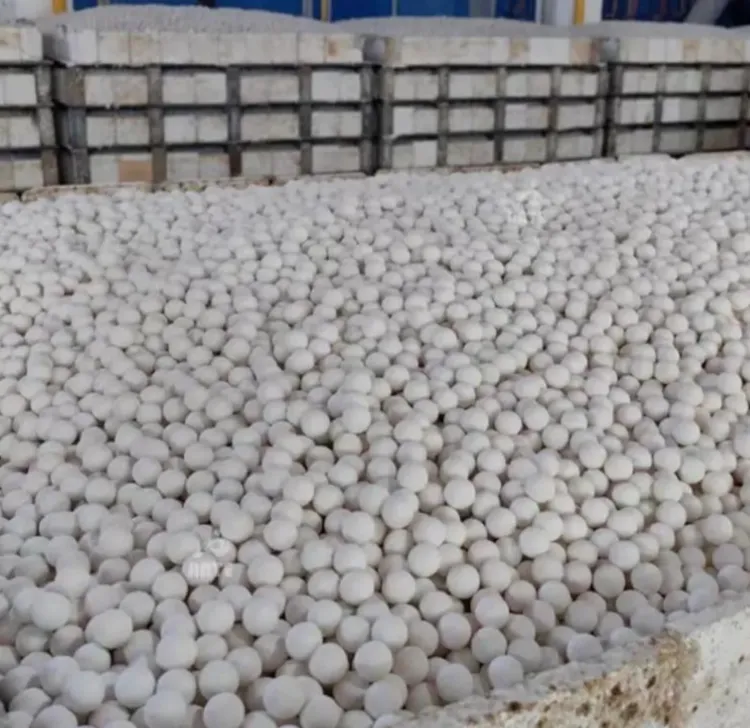
Inert alumina ceramic balls inventory stored for industrial filtration and catalyst support
Which specifications should engineers check before selecting inert alumina ceramic balls?
This is where technical procurement often succeeds or fails. A data sheet may look complete while still missing the numbers that matter most in service. Engineers should verify not only chemical analysis but also dimensional, mechanical, and operational details.
Core specification checklist
| Specification item | What to verify | Why it matters |
|---|---|---|
| Alumina purity | 99% minimum or project requirement | Controls contamination risk and chemical stability |
| Ball diameter | Exact nominal size and tolerance | Affects grading, retention, and pressure drop |
| Crush strength | Tested value by size | Predicts survival under bed load |
| Water absorption | Low, controlled value | Indicates densification quality |
| Bulk density | Lot-consistent | Important in bed weight calculations |
| Sphericity | Uniform spherical shape | Helps stable packing and load distribution |
| Surface finish | Low dust, low chips | Cleaner loading and lower fines |
| Chemical resistance | Acid and alkali behavior | Important in process fit |
| Maximum service temperature | Supplier-stated value | Supports reactor design review |
| Packaging | Moisture protection, lot traceability | Critical in transport and storage |
Typical physical property ranges seen in premium 99% alumina balls
These ranges are representative market values. Exact numbers depend on diameter and manufacturing route.
| Property | Typical range |
|---|---|
| Water absorption | Below 1.0%, often below 0.5% |
| Bulk density | About 1.8 to 2.0 g/cm³ |
| True specific gravity | About 3.5 to 3.9 g/cm³ |
| Mohs hardness | Around 9 |
| Acid resistance | Very high |
| Thermal stability | Suitable for severe process conditions |
| Loss from abrasion | Low when properly sintered |
Why crush strength should be checked by size, not by one generic line
Compressive strength rises strongly with ball diameter. A supplier that gives only one strength number is not giving enough detail. Engineers should request a size-by-size crush data table.
Indicative crush strength by size
The values below are broad industry-style examples intended for selection logic. Final procurement should rely on the supplier test report tied to the ordered diameter.
| Ball size | Indicative crush strength range |
|---|---|
| 3 mm | 0.2 to 0.6 kN |
| 6 mm | 0.5 to 1.5 kN |
| 10 mm | 1.5 to 4 kN |
| 13 mm | 3 to 8 kN |
| 19 mm | 6 to 15 kN |
| 25 mm | 10 to 25 kN |
| 38 mm | 25 to 50 kN |
| 50 mm | 40 to 80 kN |
This table should not be used as a universal acceptance standard. It is a practical comparison reference.
How should ball size and grading be chosen in a catalyst support bed?
This is one of the most searched questions around catalyst bed support media, and it is also one of the least well explained on generic product pages.
A reactor support bed usually does not contain one single ball size from bottom to top. It contains a graded arrangement. Large balls sit lower in the bed, then smaller sizes are layered upward, ending with a top support layer near the catalyst.
Why graded support beds work better than a single-size fill
A graded bed gives several advantages:
- Better load transfer to the support plate.
- Lower chance of small particles falling through large openings.
- Improved flow transition from lower plenum to catalyst bed.
- Reduced local pressure peaks on support internals.
- Better retention of catalyst pellets or extrudates.
Typical grading logic
| Layer position | Typical ball size choice | Main purpose |
|---|---|---|
| Bottom layer | Larger balls, such as 25 mm to 50 mm | Span support plate openings and carry heavy load |
| Middle layer | Medium balls, such as 10 mm to 19 mm | Transition load and reduce void size |
| Upper layer | Smaller balls, such as 3 mm to 10 mm | Support catalyst and limit migration |
| Optional top retention layer | Selected size matched to catalyst geometry | Fine-tune interface with active bed |
What controls the top layer size?
The top support layer should be chosen with these factors in mind:
- Catalyst pellet or sphere size.
- Support grid opening or slot width.
- Expected flow direction.
- Risk of catalyst migration.
- Pressure drop allowance.
- Bed loading method.
Many engineers use a practical rule: the top ball size must be large enough to remain stable and not pass through the support system, yet small enough to prevent catalyst intrusion into the deeper support layers.
Why incorrect grading causes expensive problems
If the top balls are too large, catalyst can settle into the support bed, creating:
- Uneven flow
- Catalyst breakage.
- Increased pressure drop.
- Difficult unloading during turnaround.
- Lower active bed utilization.
If the balls are too small, pressure drop may rise or the support grid may not be protected adequately.
Where are 99% inert alumina ceramic balls used in real process industries?
The application range is much broader than many buyers expect. These ceramic balls are standard in catalyst support beds, yet they also appear in other vessel internals and packed systems where inert, high-purity ceramic media is needed.
Main industry applications
| Industry | Typical use | Why 99% alumina helps |
|---|---|---|
| Oil refining | Hydrotreater, hydrocracker, reformer support beds | High purity and strong thermal stability |
| Petrochemical | Reactor support media under catalysts | Long campaigns and contamination control |
| Fertilizer | Ammonia, methanol, synthesis gas systems | Reliable mechanical support under severe service |
| Sulfuric acid and specialty chemicals | Tower or reactor ceramic media | Acid resistance and durability |
| Gas processing | Adsorber and molecular sieve bed support | Stable geometry and low dust |
| Environmental systems | Catalyst supports in treatment units | Low contamination and mechanical integrity |
| Desiccant and adsorption units | Support under active media | Prevents media loss and helps distribution |
Reactor and vessel types where these balls are common
- Fixed-bed reactors
- Axial flow catalyst vessels
- Radial flow support zones
- Desiccant towers
- Molecular sieve dryers
- Packed columns
- Adsorption beds
- Guard bed systems
Why adsorption units also use inert alumina balls
In adsorption towers, the support media stabilizes molecular sieve or activated alumina layers and protects bottom internals from dynamic load changes during switching cycles. This is especially important in pressure swing and thermal swing applications.
How do inert alumina balls compare with activated alumina, porcelain balls, and packing media?
This is a common confusion point in industrial purchasing. Many buyers see “alumina ball” and assume all ball-shaped alumina products behave the same. They do not.
Comparison table of similar-looking products
| Product type | Main structure | Main job | Not suitable if you need |
|---|---|---|---|
| Inert alumina ceramic ball | Dense, low-porosity ceramic | Support media and inert packing | Moisture adsorption |
| Activated alumina ball | Highly porous adsorbent | Drying, fluoride removal, adsorption | Heavy structural support layer |
| Porcelain ceramic ball | Lower alumina traditional ceramic | General packing and moderate support | High-purity severe process service |
| Catalyst carrier pellet | Engineered support with controlled pore structure | Carry active catalytic phase | Purely inert load-bearing support bed |
| Tower packing ball | Mass transfer packing in some columns | Liquid-gas contact enhancement | High-load catalyst bed support |
Why inert alumina is not the same as activated alumina
Activated alumina is porous and intentionally designed to adsorb water and certain contaminants. Inert alumina support media is dense and structurally focused. Swapping one for the other is a serious specification error.
Why porcelain balls may not fit premium catalyst systems
Porcelain products may be cost-effective in selected applications, yet their lower alumina content and impurity profile can make them unsuitable in units that need high chemical purity, stronger crush resistance, or better thermal reserve.
Which operating conditions can damage catalyst support media, even when the balls are high purity?
A 99% alumina ball is robust, but not indestructible. Field damage usually comes from mechanical mishandling, poor loading practice, extreme thermal shock, or process conditions outside the intended range.
Common failure modes
| Failure symptom | Likely cause | Result in the unit |
|---|---|---|
| Ball breakage during loading | Dropping from excessive height, poor handling | Dust, fines, uneven bed |
| Surface chipping | Rough transport or unloading | More fines and contamination |
| Crushing in service | Inadequate strength or poor bed design | Settling, pressure drop change |
| Cracking after startup | Severe thermal shock | Fragmentation and unstable support layer |
| Chemical attack | Process incompatibility, strong alkali at high temperature | Loss of integrity |
| Catalyst migration into support bed | Wrong top layer size | Maldistribution and difficult turnaround |
| Grid damage | Improper support bed design | Major unit reliability risk |
Why thermal shock still matters with alumina
High-purity alumina handles heat very well, yet rapid temperature cycling can still create stress if the thermal gradient is severe enough. This risk rises during:
- Fast startup
- Water ingress events.
- Emergency quench situations.
- Uneven local heating.
- Poor refractory dry-out nearby.
Why fines are more dangerous than they look
A small amount of ceramic dust can create outsized problems in sensitive units:
- Pressure drop increase.
- Plugging of lower internals.
- Contamination of catalyst.
- More difficult unloading.
- Poor flow distribution near the support plate.
That is why dust level and packaging deserve far more attention than they usually receive in purchasing discussions.
How should inert alumina ceramic balls be loaded, layered, and inspected during shutdown?
Good media can perform badly if loaded poorly. Turnaround crews should treat support media installation as precision work, not bulk dumping.
Recommended loading principles
- Confirm support grid condition before any media enters the vessel.
- Check size sequence against the loading drawing.
- Keep each size fraction clearly segregated.
- Lower balls gently rather than dropping from height.
- Spread each layer evenly across the full cross section.
- Verify final layer thickness at multiple points.
- Remove obvious broken pieces and dust before catalyst loading.
- Protect the top support layer from damage during catalyst charging.
Layer loading checklist
| Check point | What to verify |
|---|---|
| Support plate integrity | No bent, corroded, or damaged sections |
| Layer size order | Matches reactor design sheet |
| Bed thickness | Within design tolerance |
| Surface levelness | No mounds, cones, or low spots |
| Dust level | Minimal before catalyst loading |
| Top layer finish | Even surface with no obvious segregation |
| Documentation | Lot number and quantity recorded |
Why controlled loading reduces future maintenance
A carefully loaded support bed helps maintain:
- Stable pressure drop.
- Better flow distribution.
- Lower catalyst breakage.
- Easier unloading at next turnaround.
- Reduced risk of localized hot spots or cold spots.
Should the balls be washed before loading?
Most modern premium media is supplied ready to use. Washing is rarely preferred because it can introduce moisture, handling damage, and recontamination unless the procedure is tightly controlled. If a unit requires an extra-clean loading protocol, the method should be agreed in advance with process engineering and the supplier.
What should procurement teams include in an RFQ or purchase specification?
One of the strongest ways to avoid future trouble is a better RFQ. Many support media purchase orders still say little more than “99% alumina balls, 25 mm.” That is not enough in a serious plant.
Recommended RFQ content
| RFQ item | Why it should be specified |
|---|---|
| Product type | Confirms inert support media, not activated alumina |
| Al2O3 minimum | Protects purity requirement |
| Size range and tolerance | Critical in graded bed design |
| Crush strength by size | Confirms load-bearing ability |
| Water absorption maximum | Indicates densification quality |
| Bulk density | Supports bed weight calculation |
| Chemical impurities limits | Important in sensitive catalysts |
| Packing method | Prevents transit damage and moisture pickup |
| Lot traceability | Helps root-cause analysis if issues arise |
| Certificate requirements | Supports QA and regulatory systems |
Sample specification wording
AdTech Inert Alumina Ceramic Ball, catalyst bed support media, 99% Al2O3 minimum, nominal size ___ mm, low-dust dense sintered grade, suitable for reactor support service, with certified chemical analysis, crush strength data by size, water absorption value, bulk density data, and lot traceability on each package.
Why packaging details are not trivial
Strong media can still arrive damaged if packaging is weak. Buyers should verify:
- Bag type and liner quality.
- Pallet stability.
- Moisture protection.
- Net weight per bag.
- Export marking.
- Lot identification.
International transport and multiple handling points can generate more damage than the plant itself.
How should engineers evaluate supplier quality beyond the basic datasheet?
Search results often list similar-looking property tables, which can make every supplier appear equal. In real procurement, they are not.
Supplier evaluation matrix
| Category | What to ask | Why it matters |
|---|---|---|
| Manufacturing consistency | Is the product made from stable raw material and controlled firing? | Reduces lot-to-lot variation |
| Test method transparency | How are crush strength and absorption tested? | Makes comparisons meaningful |
| Dimensional control | What is the size tolerance and sphericity control? | Affects bed stability |
| Dust management | What screening or cleaning step is used before packing? | Cleaner loading and lower plugging risk |
| Field references | Has the media been used in similar reactors? | Supports practical confidence |
| Change notification | Will the supplier notify process changes? | Important in critical units |
| Technical support | Can the supplier review layer design and loading plan? | Valuable during shutdown planning |
| Emergency supply capacity | Can replacement lots be shipped quickly? | Important during turnaround pressure |
Why the cheapest quote can become the most expensive order
Lower upfront price may be erased quickly by:
- More breakage during loading.
- Higher dust generation.
- Shorter service life.
- Catalyst contamination risk.
- Longer shutdown duration.
- Increased troubleshooting cost.
In many units, the support media cost is small compared with the cost of catalyst, outage time, and lost production. That makes technical reliability the more important metric.
What common design and operating mistakes should be avoided in catalyst support media systems?
Several repeat mistakes appear across industry case histories and maintenance reports. Most are preventable.
Frequent errors
| Mistake | Short-term effect | Long-term consequence |
|---|---|---|
| Choosing size by habit instead of vessel drawing | Poor fit with support plate | Catalyst migration or unstable bed |
| Mixing size fractions during loading | Segregation and uneven transition | Channeling and pressure drop issues |
| Ignoring dust in packages | Fines enter lower plenum | Plugging and contamination |
| Using lower purity media in sensitive service | Hidden contamination source | Catalyst performance loss |
| Dropping media from excessive height | Chipping and breakage | Weak support zone |
| Skipping top layer verification | Irregular catalyst interface | Uneven flow distribution |
| No lot traceability | Root cause becomes difficult after failure | More downtime during investigation |
Why bed design should be reviewed whenever catalyst changes
A catalyst replacement project sometimes changes pellet size, shape, density, or bed depth. If the support media design stays unchanged without review, the new catalyst may interact differently with the top support layer. This is a common source of avoidable migration problems.
Why radial-flow and axial-flow systems need different attention
Both use support media, but the hydraulic behavior and load path differ. The support layer in a radial-flow system may have different retention and distribution priorities than a simple axial bed. Engineers should resist copying a support media stack from one vessel type to another without checking the internal layout.
How can plants troubleshoot pressure drop, catalyst leakage, or support bed instability?
Support media problems rarely remain hidden. They show up through process symptoms, maintenance findings, or shutdown inspection. A structured troubleshooting method helps identify the real cause quickly.
Troubleshooting table
| Symptom | Possible root cause | Corrective action |
|---|---|---|
| Rising pressure drop early in run | Excess dust, broken balls, fines migration | Review media cleanliness, loading practice, and top layer protection |
| Catalyst found below support plate | Wrong top layer size or grid issue | Redesign top layer and inspect internals |
| Uneven reactor temperature profile | Poor lower-bed distribution or settled support layer | Inspect grading, bed levelness, and support integrity |
| Broken support balls during turnaround | Inadequate crush strength or loading damage | Upgrade media quality and loading procedure |
| Unexpected contamination of catalyst | Impurity carryover from lower-grade media | Shift to higher-purity 99% Al2O3 support balls |
| Bed settling after startup | Poor layering or internal deformation | Inspect support plate and reload with proper grading |
What evidence should be collected during inspection?
- Photographs of bed layers.
- Samples of broken or intact balls.
- Dust quantity and appearance.
- Support plate condition.
- Catalyst intrusion depth into top support layer.
- Temperature and pressure data before shutdown.
- Lot numbers of support media used.
This evidence turns a vague maintenance discussion into a real engineering diagnosis.
What role do inert alumina balls play in flow distribution and pressure drop control?
Many product listings mention “support” but give little attention to hydraulic behavior. In reality, the ball bed also affects gas and liquid entry into the catalyst zone.
Hydraulic contribution of support media
A properly graded support layer can:
- Reduce jetting from support openings.
- Spread incoming fluid more evenly.
- Smooth velocity transitions.
- Limit dead zones near the bed bottom.
- Support more stable contact between fluid and catalyst.
Pressure drop balance
Support media should be designed to give enough retention and stability without creating unnecessary pressure loss. This is a balancing act.
| If support balls are too large | If support balls are too small |
|---|---|
| Catalyst may intrude into the support zone | Pressure drop may rise |
| Flow transition may remain coarse | Loading may become more sensitive |
| Retention of fines may weaken | Dust and plugging risk may increase |
| Grid protection may still be adequate | Lower plenum may see higher restriction |
Why the support zone affects catalyst utilization
If fluid enters the catalyst bed unevenly, parts of the bed may do more work than others. That reduces effective bed usage, shortens cycle length, and can contribute to thermal maldistribution. A small improvement in the support zone can improve whole-reactor behavior.
What are the main advantages of AdTech 99% inert alumina ceramic balls in procurement and field service?
AdTech buyers usually look at the product from two viewpoints. Engineers look at reliability and compatibility. Procurement teams look at consistency, documents, and delivered value. A strong support media program should satisfy both.
Practical strengths valued by technical teams
- High alumina purity suitable for sensitive catalyst systems.
- Strong crush resistance over a broad size range.
- Stable spherical shape.
- Low dust and low chipping risk when well packed.
- Good thermal and chemical durability.
- Broad use across refinery, petrochemical, and adsorption vessels.
Practical strengths valued by procurement teams
- Clear material specification.
- Traceable lot control
- Repeatable packaging quality.
- Predictable lead time.
- Technical support during RFQ and shutdown planning.
- Easier comparison of certified property data.
Why AdTech-style positioning works well in this product category
Support media is often purchased during time-critical shutdowns. That means buyers want more than a commodity bag of ceramic balls. They want confidence that the media will arrive intact, match the drawing, and perform without creating hidden risks under an expensive catalyst charge.
FAQs about inert alumina ceramic ball catalyst bed support media
99% Inert Alumina Ceramic Balls: 10/10 FAQ
1. Main purpose of an inert alumina ball in a reactor?
Its primary role is to serve as support and cover media for catalyst beds. They protect the delicate catalyst from high-velocity gas/liquid entry, prevent the support plate from clogging, and ensure an even flow distribution across the entire bed to maximize reaction efficiency.
2. Why is 99% Al2O3 (High Purity) important?
3. Is an inert alumina ball the same as activated alumina?
4. Which ball size should be used under the catalyst?
GRADING RULE
You never use a single size. Engineers design a graded bed (e.g., 20mm at the bottom, 13mm in the middle, 6mm directly under the catalyst). This “inverted pyramid” structure prevents small catalyst particles from migrating downward while maintaining a low pressure drop.
5. Can 99% alumina balls be used with molecular sieves?
6. Do inert alumina balls create a high pressure drop?
7. Are these ceramic balls resistant to acid and alkali?
8. Can support media be reused after a shutdown?
MAINTENANCE TIP
It depends on the integrity inspection. If the balls are clean, unbroken, and haven’t been “poisoned” by process contaminants, they can be screened and reused. However, many plants prefer new media to avoid the risk of hidden stress fractures or leftover catalyst dust.
9. What causes ceramic support balls to break?
Failure is usually caused by improper loading (dropping balls from a great height), poor sintering during manufacturing (leading to low crush strength), or thermal shock (extremely rapid heating/cooling cycles that cause the ceramic to crack).
10. What documents should buyers request from suppliers?
Crucial documentation includes:
- Chemical Analysis Report: Confirming Al2O3 % and SiO2 limits.
- Crush Strength Data: Minimum and average values for each size.
- Leachable Silica Test: Specifically for high-temp steam service.
- Size Distribution: Verification of diameter tolerances.
- Water Absorption: To ensure the balls are fully dense.
Final technical summary
A high-performance catalyst support bed starts with the right support media, not only the right catalyst. AdTech Inert Alumina Ceramic Ball: Catalyst Bed Support Media, 99% Al2O3 is a strong choice when the process demands chemical purity, mechanical strength, thermal reliability, and bed stability over long campaign periods. The material protects reactor internals, supports costly catalysts, improves lower-bed flow behavior, and reduces operational risk in refining, petrochemical, adsorption, and gas processing service.
The most important selection lessons are straightforward:
- Purity matters, especially in contamination-sensitive units
- Ball size grading matters just as much as chemistry
- Crush strength should be checked by diameter, not by one generic figure
- Loading quality can make or break final bed performance
- Dust, chips, and weak packaging are serious hidden risks
- A better RFQ usually prevents expensive shutdown trouble later
In short, inert alumina ceramic balls should not be treated like a simple bulk ceramic filler. They are a load-bearing, flow-conditioning, catalyst-protecting component inside some of the most valuable process vessels in industry. When engineering, maintenance, and procurement teams specify them correctly, they create a more reliable reactor from the bottom up.
Related posts:
 Theory of inert gas dehydrogenation
 Molten Metal Filter Media
 Ceramic Foam Filter Al2O3
 Alumina Porous Filter
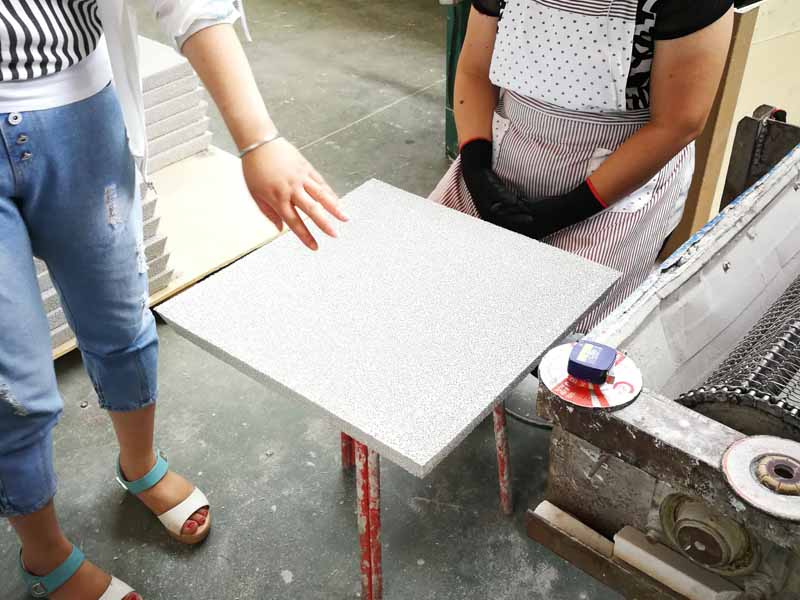 Al2O3 Ceramic Foam Filter
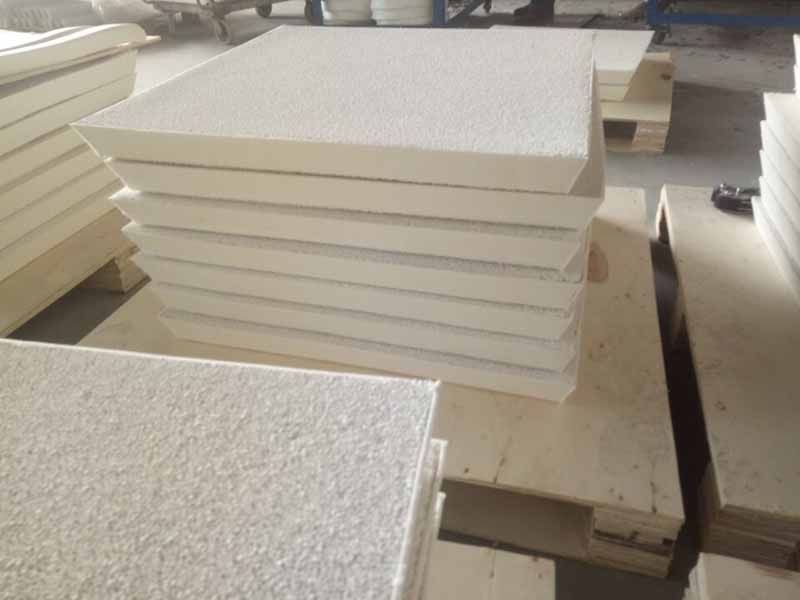 Al2O3 Foam Ceramic Filter
 Activated Alumina Ceramic Balls: High Adsorption Desiccant, Filtration Specs
 Alu Alumina Ceramic Foam Filter
Different aluminum degassing effects by using different inert gases
Alu Alumina Ceramic Foam Filter
Different aluminum degassing effects by using different inert gases
 Aluminium and filtration Wetting behavior with Al2O3 and SiC ceramic foam filters
 Al2O3 Foam Foundry Filter
Aluminum degassing effects of different inert gases
Boron Nitride Alumina Ceramic Porcelain Rod Control Pin
Alumina Ceramic Foam Filter Manufacturers
Al2O3 Foam Foundry Filter
Aluminum degassing effects of different inert gases
Boron Nitride Alumina Ceramic Porcelain Rod Control Pin
Alumina Ceramic Foam Filter Manufacturers
No Comments