
10 يناير ما هي درجة انصهار الألومنيوم؟
Aluminum melts at approximately 660.3°C (1,220.5°F) in its pure form. However, aluminum alloys do not all melt at 660°C. Their melting behavior depends on alloy composition, so aluminum foundries usually work with a melting range rather than one fixed temperature.
For aluminum producers and foundries, knowing the melting point is only the starting point. The temperature of molten aluminum during melting, holding, melt treatment, and casting can be different from the material’s melting point. Temperature control also affects oxidation, hydrogen pickup, melt cleanliness, and the quality of the final casting.
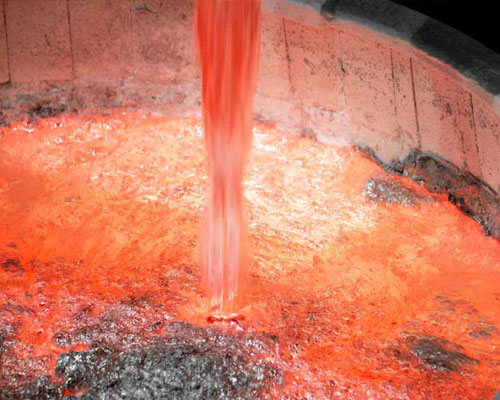
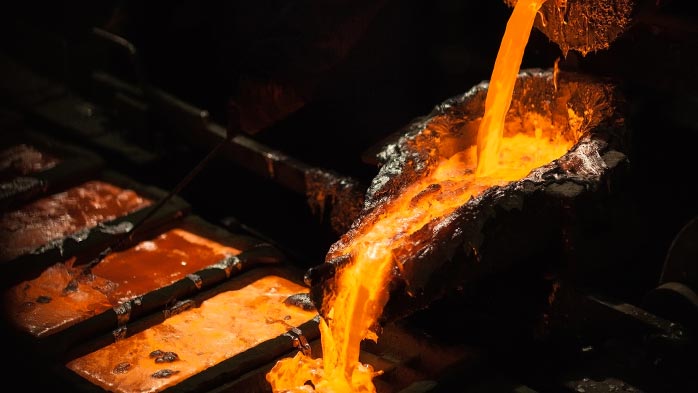
melting aluminum
ما هي درجة انصهار الألومنيوم؟
The melting point of pure aluminum is approximately 660.3°C (1,220.5°F) at standard atmospheric pressure.
At this temperature, pure aluminum changes from a solid to a liquid. Once the metal is fully molten, the temperature of the aluminum can rise above its melting point depending on the furnace setting, holding conditions, and production requirements.
It is important to distinguish the melting point of pure aluminum from the melting behavior of aluminum alloys. Commercial aluminum used in casting is usually alloyed with elements such as silicon, magnesium, copper, zinc, or manganese. These additions change the temperature at which the alloy begins and finishes melting.
For this reason, there is no single melting point that applies to every aluminum alloy.
Do aluminum alloys have the same melting point as pure aluminum?
No.
Pure aluminum has a relatively well-defined melting point, while most aluminum alloys melt over a temperature range. Two temperatures are commonly used to describe this behavior:
- Solidus temperature – the temperature below which the alloy is completely solid.
- Liquidus temperature – the temperature above which the alloy is completely liquid.
Between the solidus and liquidus temperatures, the alloy contains both solid and liquid phases.
The exact melting range depends on the alloy composition. For example, an Al-Si casting alloy behaves differently from an Al-Mg or Al-Cu alloy. This is one reason aluminum foundries normally refer to the alloy specification and its thermal characteristics rather than using 660°C as the operating temperature for every aluminum melt.
What is the difference between aluminum melting point and melting temperature?
الـ melting point describes the temperature at which a material changes phase under specified conditions. The melting temperature used in an aluminum plant refers more broadly to the temperature at which the metal is melted and prepared for the next stage of production.
These temperatures are not necessarily the same.
An aluminum furnace may heat the charge above its melting point so that the metal becomes fully liquid and remains workable. After melting, the metal may be transferred to a holding furnace or launder, where the temperature is controlled according to the alloy, casting process, production rate, and required melt quality.
For this reason, simply knowing that aluminum melts at about 660°C is not enough to determine the correct furnace or casting temperature.
What temperature is molten aluminum during casting?
There is no single casting temperature for all aluminum alloys or casting processes.
The appropriate temperature depends on factors such as:
- alloy composition
- casting method
- casting speed
- product dimensions
- mold or cooling conditions
- required surface and internal quality
- distance between the furnace and casting point
- heat loss during transfer
A temperature that works for one aluminum alloy or casting process may not be suitable for another.
In industrial production, temperature is therefore controlled throughout the process rather than simply heating the aluminum above its melting point and sending it directly to casting.
Why does molten aluminum need treatment before casting?
Melting aluminum does not automatically produce clean casting metal.
During melting and handling, molten aluminum can interact with the atmosphere and refractory materials. Oxide films and other non-metallic inclusions can enter the melt, while hydrogen can dissolve into molten aluminum.
These contaminants can become a problem during solidification.
Hydrogen is particularly important because its solubility changes significantly between liquid and solid aluminum. As the metal solidifies, dissolved hydrogen can come out of solution and contribute to hydrogen porosity.
Oxide inclusions can also affect the mechanical properties, surface quality, and integrity of aluminum cast products.
This is why industrial aluminum production often includes melt treatment between melting and casting.
How is molten aluminum purified before casting?
Two common stages of aluminum melt treatment are إزالة الغازات و الترشيح.
إزالة الغازات
Degassing is used primarily to reduce dissolved hydrogen in molten aluminum.
A rotary degassing system introduces an inert gas into the melt through a rotating rotor or impeller. Fine gas bubbles provide a large surface area for dissolved hydrogen to transfer from the aluminum into the gas phase before the bubbles rise out of the melt.
For operations requiring consistent treatment at higher production rates, an on-line degassing system can provide continuous melt treatment as aluminum moves toward the casting process.
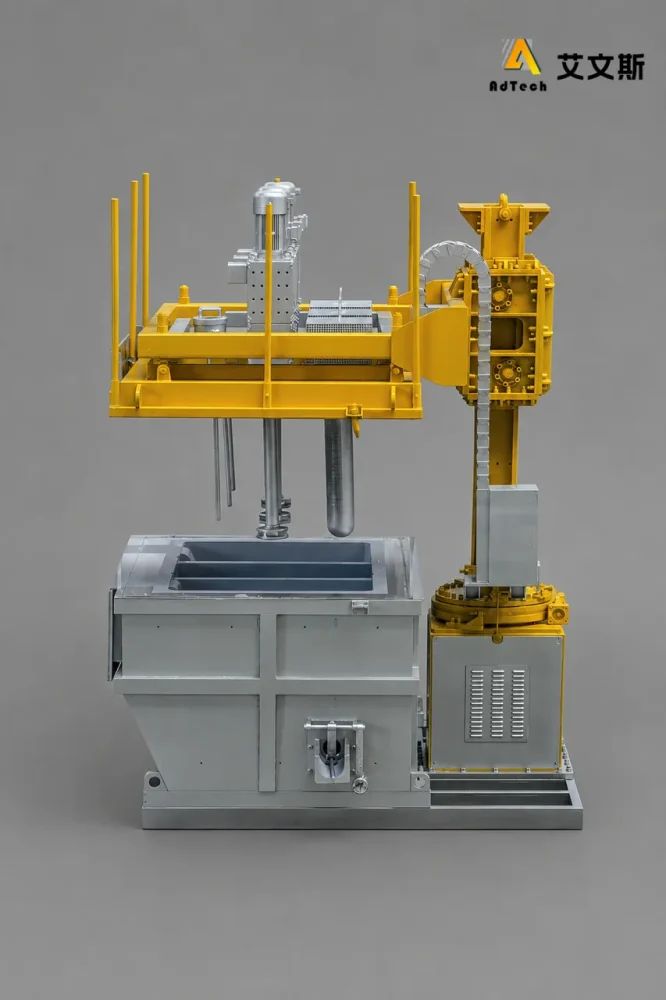
AdTech Online Degassing Aluminum Machine
Explore Our Molten-Aluminum Degassing Treatment
الترشيح
Filtration is used to remove non-metallic inclusions from molten aluminum.
A مرشح رغوي خزفي creates a tortuous flow path through which molten aluminum passes while inclusions are retained within the filter structure.
Ceramic foam filters are widely used in aluminum casting because they can provide effective inclusion removal without changing the basic composition of the alloy.
For applications with higher filtration requirements or where a different filtration configuration is needed, tubular or cartridge filtration systems may also be considered.

مرشح رغوي خزفي
Does a higher aluminum temperature always mean better melting?
No.
Once aluminum is fully molten, continuously increasing the temperature is not automatically beneficial.
Excessive overheating can increase the time the melt spends at high temperature and may contribute to oxidation and hydrogen pickup. It can also increase energy consumption and affect furnace and refractory conditions.
The practical objective is not simply to make the aluminum as hot as possible. The goal is to maintain a temperature suitable for the alloy and casting process while keeping the melt clean and stable.
This is particularly important when molten aluminum is held for extended periods or transferred over a significant distance before casting.
Why is temperature control important before aluminum casting?
Temperature affects both the behavior of the molten metal and the stability of the casting process.
If the temperature is too low, the melt may lose fluidity before or during casting. This can make it more difficult to fill the mold or maintain stable casting conditions.
If the temperature is unnecessarily high, the melt can spend more time exposed to conditions that promote oxidation and hydrogen absorption.
For this reason, aluminum plants generally need to control temperature at several stages:
Melting → Holding → Melt Treatment → Transfer → Casting
Temperature control should therefore be considered together with melt cleanliness rather than as an isolated furnace parameter.
What is the role of filtration and degassing in aluminum melt quality?
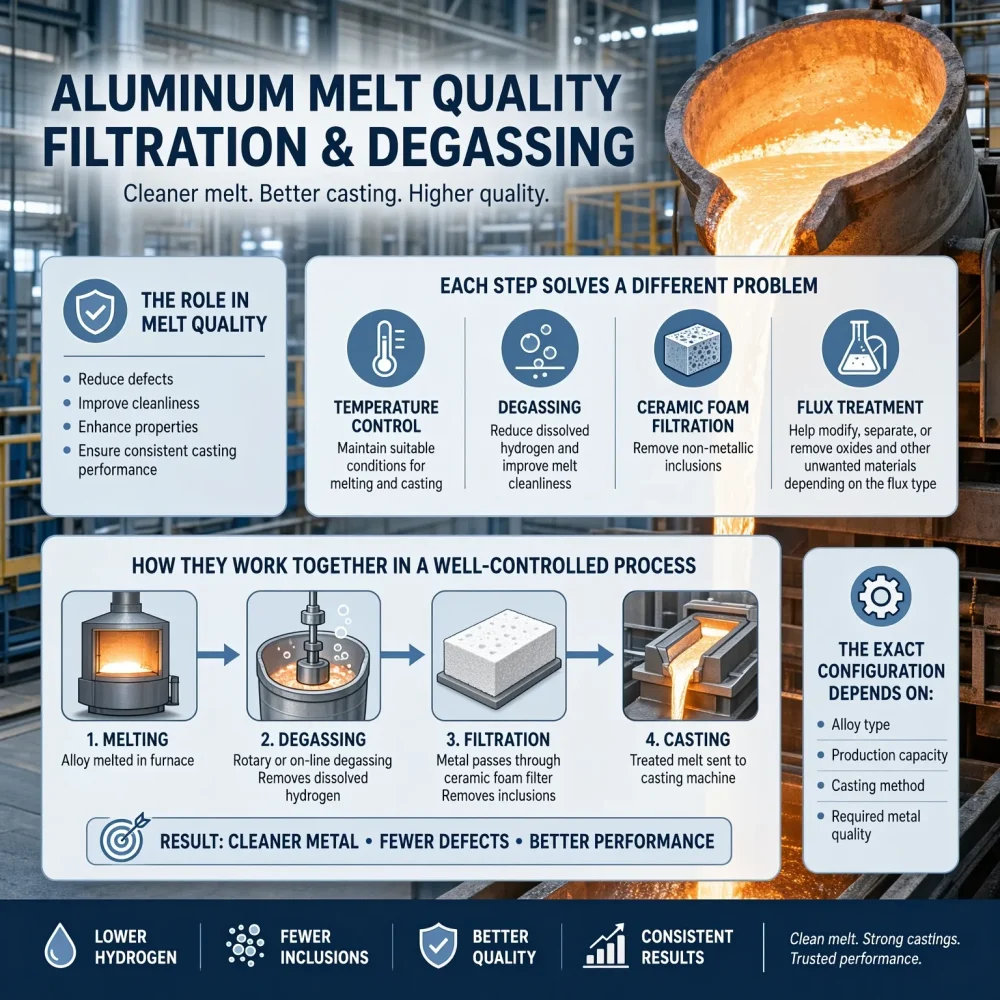
What is the role of filtration and degassing in aluminum melt quality?
Temperature control, degassing, and filtration solve different problems.
| Melt treatment | Main purpose |
|---|---|
| التحكم في درجة الحرارة | Maintain suitable conditions for melting and casting |
| إزالة الغازات | Reduce dissolved hydrogen and improve melt cleanliness |
| Ceramic foam filtration | Remove non-metallic inclusions |
| Flux treatment | Help modify, separate, or remove oxides and other unwanted materials depending on the flux type |
In a well-controlled aluminum casting process, these methods can work together.
For example, an aluminum plant may melt the alloy in a furnace, transfer the molten metal for treatment, use rotary or on-line degassing to reduce dissolved hydrogen, pass the metal through a filtration system, and then send the treated melt to the casting machine.
The exact configuration depends on the alloy, production capacity, casting method, and required metal quality.
What should aluminum producers consider beyond the melting point?
For aluminum casting, the melting point is only one part of the temperature picture.
A production team should also consider:
- the alloy’s solidus and liquidus temperatures
- target melting and holding temperatures
- transfer and casting temperatures
- melt holding time
- hydrogen level
- oxide and inclusion content
- required filtration efficiency
- casting speed and throughput
- the distance between melt treatment and casting
These factors are closely connected. A good melt treatment system should be selected according to the actual production process rather than based on melting temperature alone.
Aluminum melting point: what should you remember?
The melting point of pure aluminum is approximately 660.3°C (1,220.5°F). Aluminum alloys, however, normally melt over a range of temperatures because alloying elements change their thermal behavior.
For an aluminum foundry, knowing the melting point is only the beginning. The more important question is how to maintain the right melt temperature and cleanliness from the furnace through melt treatment and into casting.
When hydrogen and non-metallic inclusions are a concern, degassing and molten aluminum filtration should be considered alongside temperature control.
الأسئلة الشائعة
1. What is the melting point of pure aluminum?
Pure aluminum melts at approximately 660.3°C (1,220.5°F).
2. Does aluminum alloy melt at 660°C?
Not necessarily. Most aluminum alloys melt over a temperature range that depends on their alloy composition.
3. What is the difference between solidus and liquidus temperature?
The solidus is the temperature below which an alloy is fully solid. The liquidus is the temperature above which it is fully liquid.
4. What temperature is molten aluminum during casting?
There is no single casting temperature for all aluminum alloys. The suitable temperature depends on the alloy, casting process, casting speed, and product requirements.
5. Is aluminum melting point the same as aluminum casting temperature?
No. The melting point indicates when aluminum changes from solid to liquid, while casting temperature is the actual temperature used during the casting process.
6. Can overheating affect molten aluminum quality?
Yes. Excessive temperature or prolonged holding can increase oxidation and hydrogen pickup and may affect melt quality.
7. Why is hydrogen a concern in molten aluminum?
Dissolved hydrogen can form pores as aluminum solidifies, which may reduce the quality and mechanical properties of cast products.
8. How is hydrogen removed from molten aluminum?
Rotary degassing uses an inert gas and a rotating rotor to help remove dissolved hydrogen from molten aluminum before casting.
9. How are inclusions removed from molten aluminum?
Ceramic foam filters and other filtration systems are commonly used to remove non-metallic inclusions from molten aluminum.
10. Does molten aluminum need filtration after melting?
In many casting operations, yes. Filtration can help remove oxide films and other non-metallic inclusions before the metal reaches the casting stage.
مقالات ذات صلة:
 مادة الصهر المستخدمة في صهر الألومنيوم
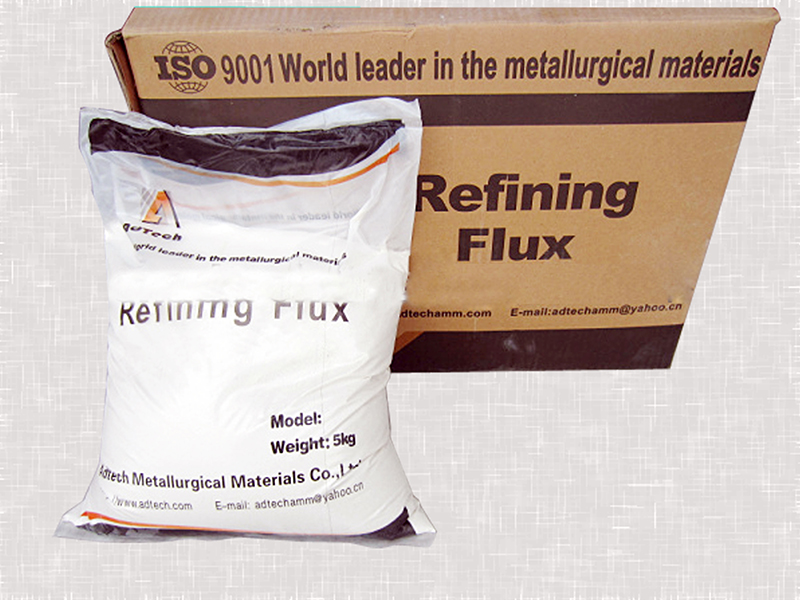 صهر الألومنيوم باستخدام تقنية «فلوكس»
 التحكم في درجة الحرارة أثناء صهر سبائك الألومنيوم
 عملية صهر الألومنيوم
 عامل السبائك المستخدم في الصهر
 إزالة الغازات من سبائك الألومنيوم
 تأثيرات مختلفة لإزالة الغازات من الألومنيوم باستخدام غازات خاملة مختلفة
 مرشح رغوي من الألومنيوم المعدني القابل للذوبان
 صهر الألومنيوم
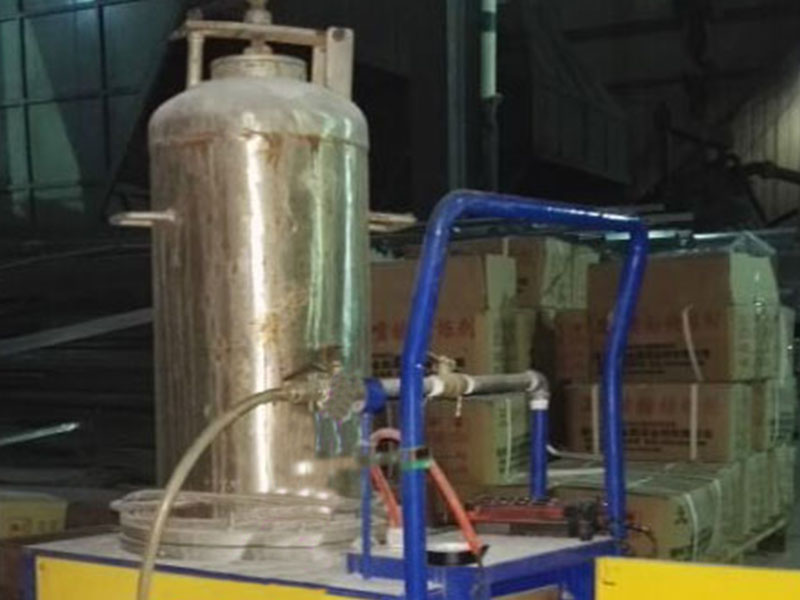 مغذي مادة التذويب في عملية صهر الألومنيوم
 صهر علب الألمنيوم لتحويلها إلى سبائك — مرشح خزفي
 إزالة الشوائب من الألومنيوم المصهور
 فقدان الألومنيوم أثناء الصهر
تأثيرات إزالة الغازات من الألومنيوم باستخدام غازات خاملة مختلفة
فقدان الألومنيوم أثناء الصهر
تأثيرات إزالة الغازات من الألومنيوم باستخدام غازات خاملة مختلفة
No Comments